


Understanding Horse Behavior and Care Classes: A Ground-Up Guide to Foundational Horsemanship
- Kim Williams

- 27 minutes ago
- 10 min read
Have you ever stood beside a horse and felt a quiet wonder mixed with a sudden, sharp realization of just how large and powerful they truly are? It's a natural feeling, and honestly, it's a healthy one. Many people feel a bit overwhelmed by conflicting advice or worry they might accidentally do something wrong that hurts the horse or compromises safety. You aren't alone in wanting a relationship built on something deeper than just hope and guesswork. This is why horse behavior and care classes are the most important first step for any student. These classes offer a chance to slow down and learn the "why" behind every ear flick and tail swish before you ever set foot in a stirrup.
In this guide, you'll discover how horse behavior and care classes provide the essential foundation for safety, trust, and a lifelong connection with your equine partners. We're going to look at the practical ways that ground-based education replaces confusion with confidence. You'll learn how to read a horse's subtle language, how to handle them with steady hands, and how to build a partnership where the horse feels just as safe with you as you do with them.
Table of Contents
Why Behavior and Care Education is the Foundation of Horsemanship
True horsemanship is much more than riding; it's a holistic study of the animal's world. Our horse behavior and care classes serve as an introduction to equine psychology, physical health requirements, and essential safety protocols. We believe in a ground-up philosophy. This means we prioritize understanding the horse's mind before we ever ask for physical performance in the saddle. When you start on the ground, you build a level of confidence that simply isn't possible if you're worried about balance and height at the same time. This approach is the heartbeat of our mission, Where Horses Inspire Learning™, because it transforms a hobby into a journey of personal growth and mutual respect.
The Safety Connection: How Knowledge Prevents Accidents
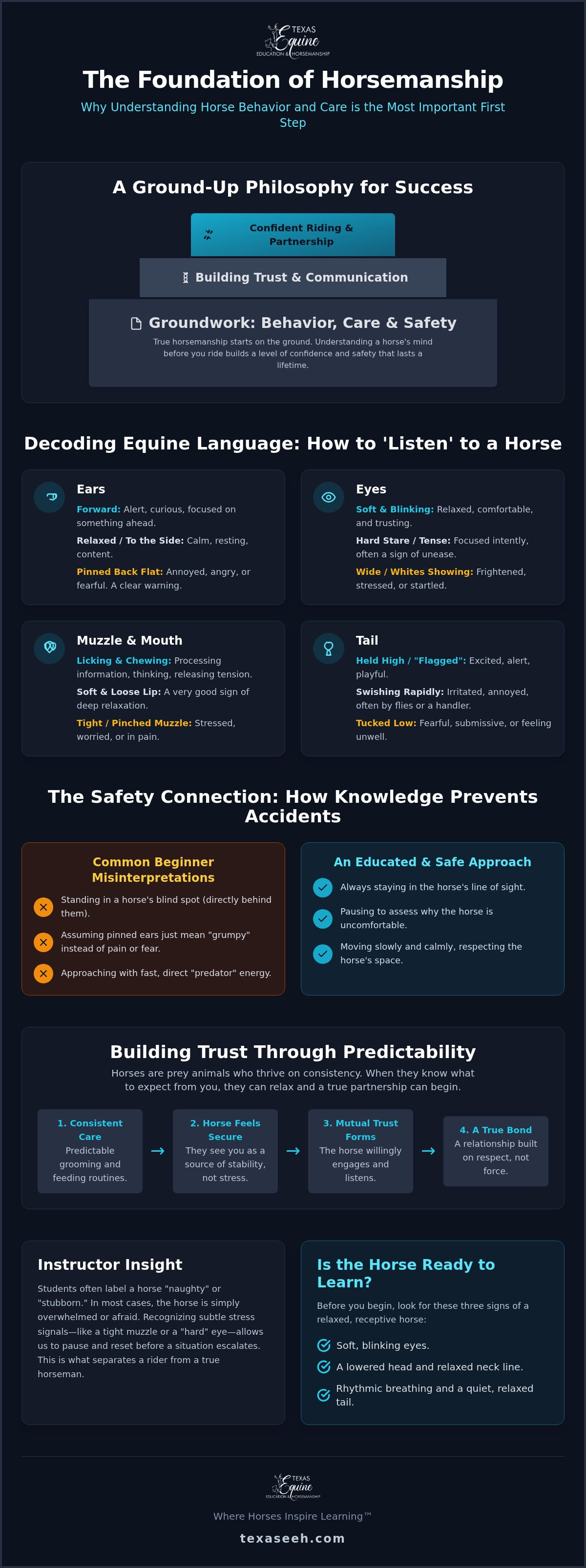
Many beginner handling errors happen because of a simple lack of information. For example, a student might stand in a horse's blind spot or misinterpret a pinned ear as grumpiness rather than a sign of pain or fear. By Understanding Horse Behavior, you learn to see these signals before they escalate into an accident. Our Foundational Horsemanship education ensures every student knows how to position themselves safely during every interaction. Knowledge is the best tool for staying safe in the barn.
Texas Equine Tip: Horses are incredibly sensitive to our internal state. Before you enter a horse's space, take a deep breath and settle your energy. Maintaining a calm, unhurried presence tells the horse that you are a safe person to be around. This simple shift in energy can prevent many common misunderstandings.
Building Trust Through Predictability
Horses are prey animals. They are constantly scanning their environment to decide if you're a source of stress or a source of stability. Consistent care routines, like feeding and grooming at the same pace every day, help a horse feel secure. Trust-based horsemanship is a two-way communication channel where the human listens as much as they lead. When a horse knows what to expect from you, they can relax. This relaxation is the first step toward a true bond. Through horse behavior and care classes, you'll learn how to be the reliable partner your horse needs. You'll gain the skills to build a relationship that is based on mutual trust rather than force.
Decoding Equine Language: What Behavior Classes Teach
Horses don't use words, but they are never silent. Their primary language is written in the tilt of an ear, the tension in a shoulder, or the depth of a sigh. In our horse behavior and care classes, we teach you how to translate these non-verbal cues into meaningful conversation. This starts with understanding the fundamental conflict of mindsets: humans are natural predators, while horses are prey animals. Every reaction a horse has is rooted in this survival instinct. When we approach them with a "predator" energy—fast, direct, and intense—they may instinctively feel the need to move away. Learning to soften your energy is the first step in bridging that gap.
Instructor Insight: Students often label a horse as "naughty" or "stubborn" when the animal doesn't comply. In most cases, the horse isn't being difficult; they are simply overwhelmed or afraid. Recognizing subtle stress signals, like a tight muzzle or a "hard" eye, allows us to pause and reset before a situation escalates. Learning these nuances is what separates a rider from a true horseman.
Reading the "Horse Talk" Vocabulary
Understanding specific terms helps you navigate the barn with greater clarity. For instance, "pressure and release" is the foundation of equine learning. You apply a cue (pressure) and remove it the instant the horse tries to respond (release). You'll also learn about the "flight zone," which is the horse's personal safety bubble, and what it means when a horse is "herd bound" and anxious about leaving their friends. These dynamics aren't just for the wild; they dictate how horses interact with us in a domestic setting every day.
Before you begin any lesson, look for these three signs that a horse is ready to learn:
Soft, blinking eyes rather than a fixed, wide-eyed stare.
A lowered head and relaxed neck line.
Rhythmic breathing and a quiet, relaxed tail.
The Science of Equine Emotions
Horses possess a complex emotional world. They process new environments through a lens of safety, and their long-term mental health depends on "unhurried learning." Pushing a horse too fast can lead to a state of "learned helplessness," where the horse complies out of fear rather than understanding. Resources like My Horse University offer excellent academic data on management, but our hands-on horse behavior and care classes focus on the emotional bond. For a deeper look at establishing these daily habits, you can review our guide on Horse Care for New Owners. If you're looking to strengthen your bond on the ground, feel free to explore our educational programs to find a class that fits your schedule.
Practical Care Fundamentals: Building Health and Trust from the Ground
Care isn't just a chore; it's a quiet conversation between you and the horse. While many people want to jump straight into the saddle, the time spent in the barn aisle is where the real partnership forms. In our horse behavior and care classes, we look at daily routines—grooming, nutrition, and environment management—not as separate tasks, but as a holistic way to support the horse's well-being. This "dirty work" is actually the foundation of your bond. It's where you learn the horse's baseline so you can spot when something is off.
Safety Reminder: Always stay aware of your surroundings while performing care tasks. A horse can shift their weight or react to a sudden noise in a heartbeat. Staying present and keeping your feet in a safe position ensures both you and the horse remain calm and secure throughout the process.
Horse Talk: You've likely heard the phrase "no hoof, no horse." Hoof health is the most critical physical care skill you'll learn. Picking out hooves daily allows you to check for thrush, cracks, or lodged stones that could cause discomfort or lameness. It also teaches the horse to balance on three legs and trust you with their weight.
Grooming as Communication
Grooming is a behavior assessment disguised as a beauty treatment. As you move from the curry comb to the dandy brush, you're feeling for heat, swelling, or new sensitivities. It's also the perfect time to find those "itchy spots" that make a horse lean in with pleasure, which builds a positive association with your presence. For a detailed look at the tools and techniques we use, read our article on Horse Grooming and Care Basics.
Nutrition and Wellness Basics
A horse's digestive system is surprisingly delicate. Common beginner mistakes often involve overfeeding high-energy grain or failing to recognize that horses are designed to graze for the majority of the day. Access to clean water and high-quality forage is the absolute priority for equine health. By watching a horse's behavior during feeding, you can spot early signs of illness. A horse that is usually eager but suddenly acts lethargic or refuses a meal is often signaling that they aren't feeling well. If you're ready to learn these vital skills in person, we invite you to explore our Equine Care Classes to begin your education.
Selecting the Right Educational Environment for Your Equine Journey
Choosing where you begin your horsemanship journey is a decision that shapes your entire relationship with animals. A supportive, unhurried environment is essential because learning happens best when both the student and the horse feel safe. High-pressure methods might produce quick results, but they often come at the cost of the horse's spirit and the rider's confidence. Our horse behavior and care classes are designed to be a peaceful entry point for families and individuals. We prioritize the "why" behind every action, ensuring you understand the purpose of your work before you ever feel the pressure of performance.
For those who want to take their passion further, the Equine Industry Readiness Program™ offers a professional path. This program provides the depth needed for those considering a career in the equine world. We also believe that horses can inspire growth in other areas of life. Initiatives like The Reading Rein™ connect literacy with horsemanship, showing that the barn is a place for holistic learning. These programs ensure that education remains the focus of every interaction.
Virtual Learning and Community Support
You don't always have to be in the barn to keep learning. Virtual education sessions held every Thursday provide a way for busy families to build their knowledge base from home. These sessions help you stay connected with equine education year-round, regardless of the weather or your schedule. Students can even demonstrate their progress through online events like the Horse & Rider Showcase™. This program allows you to track your growth in care and behavior skills in a low-stress setting. We also celebrate the beauty of these animals through the Equine Expression & Heritage Art Show, proving that horsemanship is a creative and cultural experience as much as a physical one.
The Texas Equine Approach to Lifelong Learning
A nurturing mentor approach is superior to high-pressure training because it respects the individual pace of every learner. We act as a bridge between specialized equine knowledge and the general public, making sure our horse behavior and care classes are accessible to everyone. If you're ready to find the right starting point for your family, we invite you to explore our services page. Every interaction with a horse is a fresh chance to learn something new. Each moment in their presence is an opportunity to grow in patience, leadership, and empathy.
Taking Your Next Steps with Confidence
Starting your horsemanship journey from the ground up is the kindest gift you can give yourself and your horse. You've seen how understanding equine psychology and mastering the art of grooming creates a foundation of safety that lasts a lifetime. These horse behavior and care classes aren't just about learning facts; they're about developing a language of mutual respect. By decoding a flick of an ear or learning the vital importance of hoof health, you build the confidence needed to be a true partner.
Our community offers many paths to deepen this connection. You might join our weekly virtual education community to stay inspired or explore the professional standards of the Equine Industry Readiness Program™. For those who love how horses and literacy go hand in hand, The Reading Rein™ national literacy program provides a unique way to learn. Each of these steps ensures you're never walking this path alone. Continue your learning by exploring our foundational equine services and see where this transformative experience can take you. We're here to support you every step of the way.
Frequently Asked Questions
What is the first thing I should learn about horse behavior?
The most fundamental concept to understand is that horses are prey animals. This means their primary instinct is to seek safety through flight. Learning how to recognize their "flight zone" and how they perceive humans as potential predators is the first step in building a safe relationship. When you understand that a horse's reaction is based on survival rather than defiance, you can approach them with the calm energy they need.
Can I take horse care classes online if I don’t own a horse yet?
Absolutely, and we actually recommend it. Taking horse behavior and care classes virtually is an excellent way to build your knowledge before you ever step into a barn. Our weekly virtual education sessions allow you to learn about nutrition, health, and communication from the comfort of home. This preparation ensures that when you do interact with a horse, you feel confident and ready to handle them with the care they deserve.
Are these classes suitable for children and homeschool families?
Yes, our programs are designed to be inclusive and family-friendly. We welcome homeschool families and offer specialized sessions like Tiny Tot Lessons for our youngest learners. Programs such as The Reading Rein™ also help children connect literacy with their love for horses. Our goal is to create a nurturing environment where students of all ages can learn through horses. This approach helps build self-assurance and empathy in a safe, unhurried setting.
How long does it take to become comfortable handling a horse on the ground?
Every student's journey is unique, so there's no fixed timeline. Some people feel steady after a few sessions, while others prefer to take their time over several months. We prioritize an unhurried learning pace to ensure you truly understand the "why" behind each action. Consistently attending horse behavior and care classes helps you develop the muscle memory and intuition needed to handle horses safely and effectively in various situations.
Do behavior classes count toward professional equine certifications?
While basic classes focus on foundational skills, we offer a dedicated path for those seeking professional development. Our Equine Industry Readiness Program™ is an eight-week segment designed to prepare students for careers in the horse world. This program builds on basic behavior and care knowledge to provide a more technical and professional understanding. It's a great choice for students who want to turn their passion into a recognized set of industry skills.
What equipment do I need to start a horse care class?
You don't need a lot of expensive equipment to get started. For safety, we require all students to wear sturdy, closed-toe boots, preferably with a small heel. Comfortable, weather-appropriate clothing that you don't mind getting a little dusty is also important. We provide the grooming tools and horses for our in-person sessions. If you're attending our virtual education sessions, all you need is a notebook and a curious mind to begin your learning.


Comments