


Horse Care Workshops for Kids: Quality Equine Education
- Kim Williams

- 19 hours ago
- 10 min read
What if your child’s natural curiosity about horses could be the key to building their lifelong confidence and sense of responsibility? It's common for parents to feel a mix of excitement and anxiety when their little ones ask to spend time at the barn. You might worry about physical safety around such large animals or feel frustrated by programs that offer simple pony rides rather than real education. Finding high-quality horse care workshops for kids shouldn't feel like a guessing game filled with confusing technical terms. You deserve to know that your child is learning in a space where their emotional well-being is just as important as their physical safety.
We believe that true horsemanship begins on the ground, long before a student ever steps into a stirrup. In this article, you'll discover how to identify workshops that prioritize foundational skills and a child's unique developmental growth. We will look at how to choose a program that teaches horse behavior and connects literacy with physical activity. By the end, you'll feel empowered to select an educational environment where horses inspire learning and help your child grow into a capable, compassionate handler.
Table of Contents
Why Foundational Horse Care Education Matters for Children
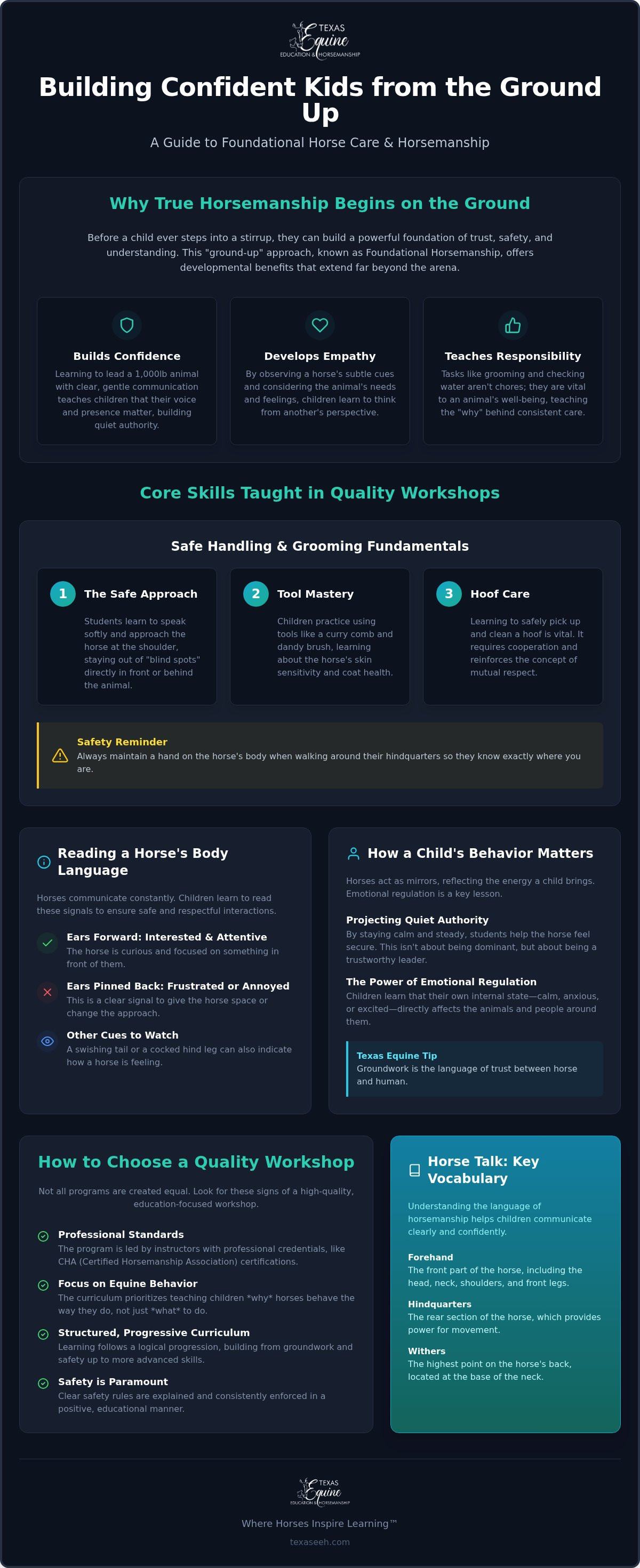
Many families believe that learning about horses only happens when a child is sitting in a saddle. However, our philosophy is rooted in the idea that horses act as mirrors for human behavior. They reflect back the energy and intention a child brings to the barn, creating a unique environment where horses inspire learning™. By participating in horse care workshops for kids, students learn to observe these subtle cues. This ground-up approach is what we call Foundational Horsemanship. It prioritizes safety and understanding before a foot ever touches a stirrup, ensuring that every interaction is built on a solid base of knowledge.
Non-riding education offers developmental benefits that go far beyond the arena. When children engage with horses on the ground, they develop empathy by considering the animal's needs and feelings. They also practice problem-solving as they learn how to navigate the horse's space safely. This approach helps dismantle the misconception that equine education is just about riding; instead, it's about building a holistic relationship with a living being.
Building Confidence Through Groundwork
Standing next to a thousand-pound animal can be intimidating for anyone, especially a child. Groundwork allows kids to build self-assurance by learning to lead, halt, and back up a horse with clear body language. When a horse responds to a child's gentle request, it reinforces that their voice and presence matter. Clear communication is the key here. Students learn that their posture and focus directly impact the horse's response, which builds a sense of quiet authority and readiness.
Texas Equine Tip:
Groundwork is the language of trust between horse and human.
The Role of Responsibility in Equine Care
Horses require consistent care, which provides a natural setting for children to learn about responsibility. Tasks like grooming or checking water buckets aren't just chores; they are essential parts of the animal's well-being. During these horse care workshops for kids, students also learn "Horse Talk." This specialized vocabulary helps them describe everything from a horse's anatomy to the tools in a grooming kit. Understanding the "why" behind every action helps them connect deeply with the animal. This focus on the basics creates a strong foundation for future growth in various education programs.
Essential Skills Taught in Quality Horse Care Workshops
A structured curriculum is what separates a simple barn visit from true equine education. In high-quality horse care workshops for kids, students follow a logical progression that builds both technical ability and emotional intelligence. This journey starts with the most critical skill of all: safety. By understanding the "why" behind every rule, children learn to respect the horse's size and instincts while developing the confidence to work alongside them. These workshops prepare students for more advanced goals, such as participating in the Horse & Rider Showcase™, where they can demonstrate their growing partnership.
Safe Handling and Grooming Fundamentals
Grooming is the perfect time for a student to bond with their horse while performing a health check. A quality workshop will guide children through these three foundational steps:
Step 1: The Safe Approach. Students learn to speak softly and approach the horse's shoulder, avoiding "blind spots" directly in front of the nose and behind the tail.
Step 2: Tool Mastery. Children practice using a rubber curry comb in circular motions to loosen dirt, followed by the flicking motion of a dandy brush. This teaches them about the horse's skin sensitivity and coat health.
Step 3: Hoof Care. Learning to safely pick up and clean a hoof is vital. It requires the student to ask the horse for cooperation, reinforcing the concept of mutual respect.
Safety Reminder:
Always maintain a hand on the horse's body when walking around their hindquarters so they know exactly where you are at all times.
Understanding Equine Behavior and Body Language
Horses communicate constantly through their posture. Children are taught to read ear positions; forward ears show interest, while ears pinned back signal frustration. They also learn to watch for tail swishing or a cocked hind leg. By staying calm and steady, students project a "quiet authority" that helps the horse feel secure. This emotional regulation is a key takeaway from horse care workshops for kids, as it teaches children that their internal state affects those around them.
Horse Talk:
Forehand
(the front part of the horse),
Hindquarters
(the rear section), and
Withers
(the high point of the back located between the shoulder blades).
Instructor Insight:
A common beginner mistake is being too quiet or "sneaking up" on a horse to avoid scaring them. Because horses are prey animals, they find sudden, quiet movements more startling than a confident, audible approach. Always let them know you're coming with a kind word.
If you're interested in seeing how these skills translate into a professional environment, you might explore our full range of education programs to find the right fit for your family.
How to Evaluate and Choose the Right Horse Workshop
Selecting the right environment for your child is a decision that requires looking beneath the surface. While many facilities offer activities, high-quality horse care workshops for kids prioritize a structured approach that values safety and individual progress. You want a program that acts as a bridge between curiosity and competence. Start by asking if the facility has a clear educational path, such as Equine Care Classes, which ensure students aren't just visiting the barn but are actively learning horsemanship.
Small group sizes are another non-negotiable factor. In a crowded arena, an instructor cannot provide the focused attention required to ensure every child handles their horse correctly. Professional certifications, such as those from the Certified Horsemanship Association (CHA), provide peace of mind that the staff understands both equine safety and youth instructional techniques. These standards ensure the environment remains tranquil and supportive for everyone involved.
Safety Standards and Environment Assessment
A professional facility should feel organized and calm. When you visit, look for secure fencing, clean stalls, and gear that is well-maintained and appropriately sized for children. The temperament of the horses is equally important; they should be patient and accustomed to the high energy of young learners. If the horses seem stressed or the equipment is worn, it’s a sign that safety might not be the top priority. Use this quick checklist when visiting a new barn:
Instructor certifications and a background in youth education.
Small student-to-teacher ratios for personalized safety monitoring.
Well-maintained facilities and gear designed for young riders.
A structured syllabus that outlines specific horsemanship goals.
Instructor Insight:
A dedicated educator will always prioritize a child's comfort level over pushing for quick results. If a student feels nervous, we slow down. True progress happens when a child feels safe enough to be curious.
Curriculum vs. Entertainment: Identifying Real Learning
It’s easy to mistake entertainment for education. To find real substance, ask for a syllabus or a list of learning goals. Even our Tiny Tot Lessons follow a structured plan tailored to early developmental stages. A quality program should also offer resources beyond the arena. For example, an on-site Equine Library and Learning Center allows children to connect literacy with their physical activities, reinforcing what they learn during their horse care workshops for kids.
Ready to find a structured path for your young equestrian? You can explore our current education programs to see how we put these standards into practice every day.
Beyond the Stable: Integrating Literacy and Equine Education
Learning doesn't stop at the barn door. Physical activity in horse care workshops for kids provides a vivid context for academic exploration that stays with a child long after they leave the arena. When a student handles a horse, they aren't just practicing a physical skill; they're engaging their minds in a way that sparks curiosity about science, history, and literature. By connecting the tangible sensations of the stable with the stories found in books, we help children understand the "why" behind their actions. This holistic approach ensures that every lesson at the ranch supports their growth in the classroom.
The Reading Rein™: Incentivizing Learning
Our literacy initiative, The Reading Rein™, is a wonderful way to keep the spark of learning alive at home. We've designed this program to encourage children to explore horse-themed literature by offering prizes and incentives for the books they complete. It's about more than just reading; it's about building a knowledge base that reinforces their hands-on training. Our curated equine library, which is part of our broader Horse Literacy Program, serves as a hub for young researchers. Whether they're curious about different breeds or historical horsemanship, these resources allow them to dive deeper into the subjects they love.
Building a Lifelong Connection with Horses
These early workshops often plant the seeds for a permanent respect for the heritage and art of the horse. We love seeing families participate in community events like the Equine Expression & Heritage Art Show, where students can see horses as a source of creative and cultural inspiration. These experiences help children view themselves as part of a larger community of equine advocates. It's a journey that builds confidence and a sense of belonging from the very first day.
For some students, these initial workshops are the first step toward a professional path. As they grow, they may find themselves ready for more advanced challenges, such as the Equine Industry Readiness Program™. This progression ensures they're always moving forward in their education. We invite you to continue your learning through our virtual education resources or by participating in upcoming showcase events. Every interaction with a horse is an opportunity to learn something new about the world and about yourself.
Building a Foundation Where Horses Inspire Learning™
Choosing the right educational environment ensures your child develops more than just riding skills; they build empathy, responsibility, and a deep understanding of animal behavior. By prioritizing safety standards and a structured curriculum over simple entertainment, you're setting the stage for a lifelong connection with these incredible animals. We've seen how integrating literacy through programs like The Reading Rein™ and offering specialized Tiny Tot education can transform a child’s confidence both in and out of the barn.
Quality horse care workshops for kids offer a safe space for this growth to begin from the ground up. As the founder of the Horse & Rider Showcase™, we are dedicated to providing a clear path for every young learner to succeed. You can explore additional educational resources and programs for young riders at Texas Equine Education & Horsemanship™ to find the perfect starting point for your family. We look forward to being part of your child’s journey as they discover the joy and wisdom that horses have to share.
Frequently Asked Questions
What is the best age for a child to start a horse care workshop?
Children as young as three can begin their journey through our Tiny Tot Lessons, which focus on sensory learning and basic barn safety. For more structured horse care workshops for kids, we find that age seven is a wonderful milestone. At this age, most children have the physical coordination to handle grooming tools and the attention span needed to understand the "why" behind equine behavior and safety protocols.
Are horse care workshops safe for children with no prior experience?
Yes, these programs are specifically designed for beginners. We prioritize a ground-up approach that teaches students how to navigate a horse's environment safely before they ever attempt to handle an animal. By focusing on foundational horsemanship and clear safety reminders, we build a child's confidence at a steady pace. This ensures that even those who have never seen a horse in person feel secure and supported.
What should my child wear to a horse care or horsemanship class?
Proper attire is a key part of barn safety. Your child should wear long pants, like jeans or breeches, and sturdy, closed-toe boots with a small heel to protect their feet. It's best to avoid baggy clothing or dangling jewelry that might get caught on equipment. We also suggest dressing in layers, as the temperature in a stable or arena can change quickly during our various education programs.
Do horse care workshops always include riding lessons?
Not every workshop includes time in the saddle. Many of our horse care workshops for kids focus exclusively on groundwork, grooming, and health management. These non-riding sessions are essential because they teach children to respect the horse as a living being rather than just a mount. Building this bond on the ground creates a much stronger and safer foundation for when a student eventually begins their riding journey.
How can I reinforce horse care learning at home?
You can keep the learning alive by encouraging your child to participate in The Reading Rein™. This program uses horse-themed literature to bridge the gap between the stable and the classroom. Discussing the "Horse Talk" vocabulary they learned or visiting our equine library can also help. These activities reinforce the responsibility and empathy they practice at the barn, making the lessons a natural part of their daily life.
What makes a 'ground-up' approach different from traditional riding lessons?
A ground-up approach prioritizes the horse's mind and the handler's safety before riding is ever introduced. While traditional lessons often focus on mechanics in the saddle, we believe true horsemanship starts with understanding equine psychology. Students learn to read body language and communicate through subtle cues on the ground. This methodical process develops a "quiet authority" in children, ensuring they are prepared for the responsibilities of the Horse & Rider Showcase™.


Comments