


Horsemanship for First Responders: Essential Skills

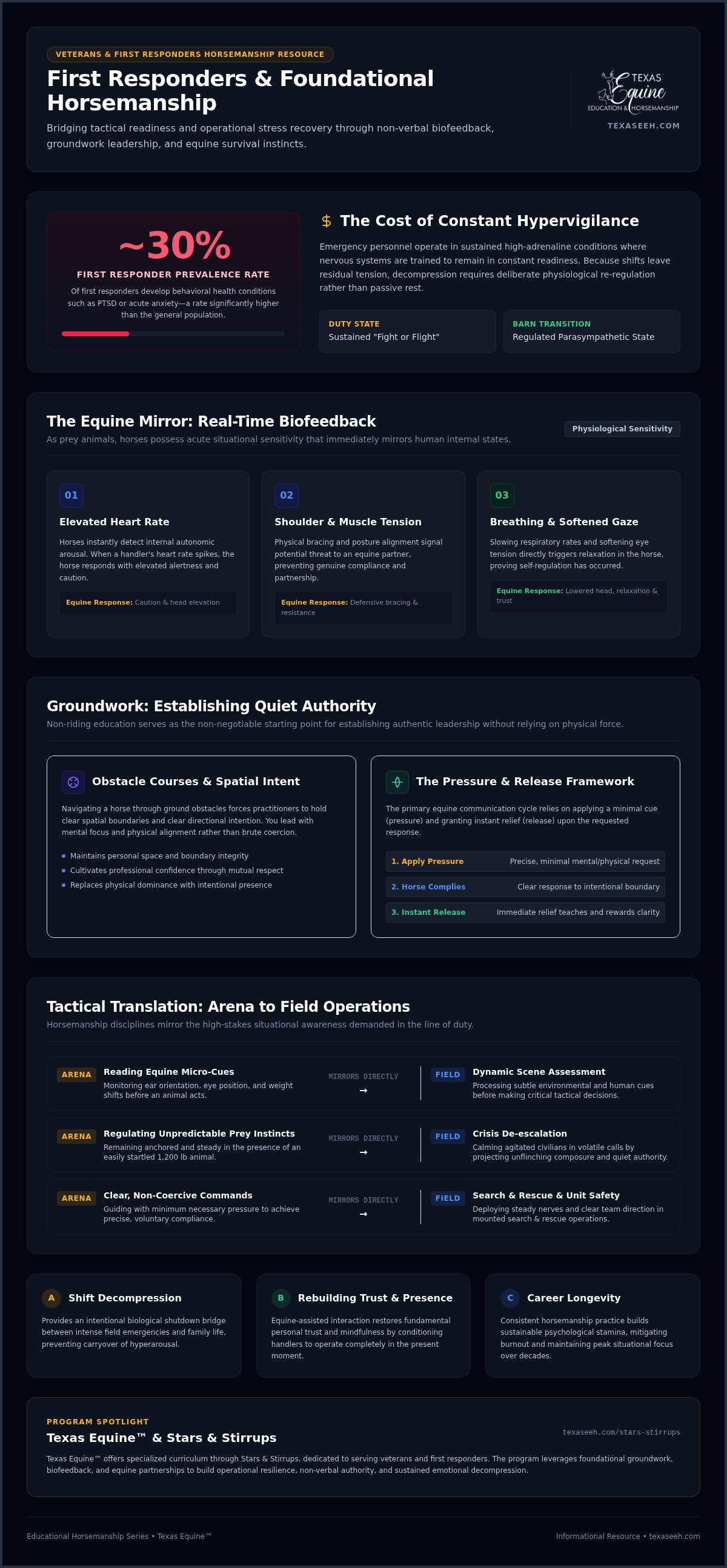
Approximately 30% of first responders develop behavioral health conditions like PTSD or acute anxiety, a rate significantly higher than the general population. If you've spent years in high-stress environments, you know that the weight of a shift doesn't always stay at the station. It's often difficult to decompress when your nervous system is trained to remain in a state of constant hypervigilance. You deserve a space where you can safely process that tension while building skills that enhance your professional performance. The intersection of first responders and horsemanship offers a transformative way to bridge the gap between tactical readiness and personal well-being.
This article explains how foundational horsemanship provides you with essential tools for emotional regulation, non-verbal communication, and tactical leadership. We will examine the parallels between equine survival instincts and professional situational awareness. You'll discover how these quiet, powerful animals act as mirrors for your internal state, helping you cultivate a sense of tranquility and growth that serves you both in the arena and on the job.
Table of Contents
The Connection Between First Responders and Horsemanship
Horsemanship for responders is fundamentally the study of equine behavior to improve human self-awareness. While your professional life often requires operating in high-adrenaline environments, the barn offers a necessary counter-balance built on a nurturing and supportive atmosphere. Horses possess an acute sensitivity to their surroundings because they're prey animals. They act as living mirrors for human emotional states and physiological stress, reflecting your internal tension before you might even realize it's there. If your heart rate is elevated or your muscles are tight, the horse will respond with caution. By approaching these animals with tranquility and respect, you create a foundation for a partnership that values presence over pressure. This unique bond between first responders and horsemanship fosters a deep understanding of how your energy impacts those around you.
Emotional Regulation and Decompression in the Barn
Entering a stable requires a significant biological shift. You move from the high-alert "fight or flight" state common in emergency services to a grounded, parasympathetic state. This transition is vital for long-term health and shift recovery. Building trust with horses isn't about physical dominance; it requires a calm and intentional presence that the animal can rely on. When you slow your breathing and soften your gaze, the horse begins to relax, signaling that you've successfully regulated your own nervous system. This practice directly builds personal resilience and emotional stability. Beyond the emotional benefits, these skills have practical applications in fields like mounted search and rescue, where clear communication and steady nerves are essential for mission success. Developing this quiet authority helps you decompress effectively, ensuring you return to your duties with a renewed sense of balance and focus.
Developing Leadership and Communication Skills Through Groundwork
Beginning with non-riding horse education is the most critical starting point for professionals. This foundational work allows you to establish clear, quiet authority without the need for physical force. In your professional life, leadership often depends on your ability to remain calm while directing others. Groundwork mirrors this dynamic. By leading a horse through an obstacle course, you practice maintaining your space and intention. This process heightens your situational awareness. Reading a horse's ear position or weight shift is strikingly similar to reading a scene during a call. Both require you to process subtle environmental data before making a tactical decision. This step-by-step journey in first responders and horsemanship builds a unique brand of professional confidence rooted in stability and mutual respect.
Non-Verbal Cues and Tactical Communication
Horses are masters of non-verbal cues. They respond instantly to your body alignment and the tension in your shoulders. Research into equine-assisted therapy for first responders shows that these interactions help rebuild personal trust and mindfulness. Learning to handle horses safely is also a profound study in boundary setting. You'll use the pressure and release framework to communicate. You apply a small amount of mental or physical pressure to request a movement and immediately release it when the horse complies. This cycle teaches you to be precise with your requests and generous with your rewards. If you're ready to explore these foundational concepts, you might consider starting with horsemanship lessons to begin your development. These skills ensure you lead with clarity rather than coercion.
Transitioning Horsemanship Skills from the Arena to the Field
As you transition these skills to the field, consider how other tactical proficiencies can benefit from your improved focus. For instance, AINautics University provides drone training that requires the same level of precision and situational awareness as advanced horsemanship.
The patience you cultivate while mastering horsemanship skills serves as a powerful tactical tool during high-pressure public interactions. In the field, civilians in crisis often mirror the unpredictability of a sensitive animal. By maintaining your composure and using steady non-verbal cues, you can de-escalate volatile situations with quiet authority. This methodical approach to first responders and horsemanship rewards consistency and helps ensure career longevity by providing a sustainable way to manage occupational stress. Research into equine-assisted learning and leadership shows that these exercises provide a practical model for team building and resilience.
Progress in the barn is a methodical, unhurried process that values steady growth over immediate results. This environment allows for deep decompression, helping you leave the weight of a shift behind. Engaging with a supportive community of peers who share your professional background creates a safe space for personal evolution and mutual understanding. This connection between first responders and horsemanship fosters a sense of tranquility that extends far beyond the arena walls.
Stars & Stirrups: A Specialized Program for Heroes
The Stars & Stirrups program is specifically designed to support the wellness of first responders and veterans through an education-first approach. By focusing on foundational horsemanship and equine care, participants find a clear pathway to personal growth and emotional stability. Texas Equine™ provides this specialized initiative to foster resilience and confidence among our nation's heroes. You can find more information about the program and how to engage with this community at stars stirrups.
Cultivating Resilience Through Foundational Horsemanship
Foundational horsemanship is more than just a hobby; it's a tactical study in presence and emotional regulation. By understanding equine behavior, you gain a unique mirror for your own physiological stress, allowing you to master decompression after a demanding shift. The quiet authority developed through groundwork translates directly to your field performance, enhancing your situational awareness and non-verbal communication skills. This methodical approach to first responders and horsemanship ensures that your growth is steady, unhurried, and deeply restorative. Texas Equine™ is committed to serving those who serve our communities through an education-first philosophy that prioritizes your well-being. You're invited to learn more about our specialized support for heroes through Stars & Stirrups. Your journey toward tranquility and personal growth is a step-by-step process, and we're here to guide you through every gate.
Frequently Asked Questions
How exactly does horsemanship help first responders with stress?
Horsemanship helps manage stress by providing real-time biofeedback through the horse's reactions. Because horses are sensitive to heart rate and muscle tension, they mirror your internal state instantly. This interaction encourages you to consciously regulate your breathing and energy to keep the animal calm. It's an effective way for first responders and horsemanship participants to practice transitioning from a high-alert state to a grounded one.
Do I need previous experience with horses to join a responder program?
No previous experience with horses is necessary to participate in these programs. We prioritize a foundational, ground-up educational philosophy that ensures every participant feels safe and supported from day one. You'll begin by learning basic equine care and safe handling techniques. This step-by-step approach builds your self-assurance at a comfortable pace, making the experience accessible to everyone regardless of their background.
Is groundwork more effective than riding for leadership development?
Groundwork is exceptionally effective for leadership development because it focuses on the essential "why" behind every interaction. By working with a horse from the ground, you learn to establish boundaries and use quiet authority without the physical distractions of riding. This face-to-face communication builds trust and situational awareness. It requires clear intentions and consistent body language, which are vital skills for professional leadership in high-pressure fields.
What is the Stars & Stirrups program at Texas Equine™?
Stars & Stirrups is a specialized program at Texas Equine™ designed specifically for veterans and first responders. It follows an education-first approach, focusing on foundational horsemanship and equine care rather than just riding. This national resource provides a supportive community where heroes can focus on personal growth. The program emphasizes the therapeutic benefits of first responders and horsemanship while building practical, transferable skills for daily life.


Comments