


Horse Safety: Essential Tips for Every Rider

Did you know that US Equestrian recorded over 7,500 rider falls in 2025 alone? Many of these incidents, along with common ground injuries like kicks or bites, often stem from a simple misunderstanding of horse safety and natural equine instincts. While building skills to prevent such accidents is paramount, being prepared to respond effectively with training from Coolangatta First Aid & CPR Training is just as vital for anyone working with horses. It's completely natural to feel a sense of hesitation when you're standing next to a powerful animal. You want to feel secure and connected, yet the subtle shifts in their ears or tail can sometimes feel like a foreign language that's hard to decode.
This guide will help you master the essential principles of equine behavior and ground-up safety protocols to build a confident, secure partnership with horses. We'll explore how to interpret body language, choose gear that meets the latest safety standards, and develop the calm readiness needed to handle horses with ease and respect. By understanding the why behind every interaction, you can transform uncertainty into a steady, knowledgeable bond.
Table of Contents
Understanding Equine Behavior: The Psychology of Horse Safety
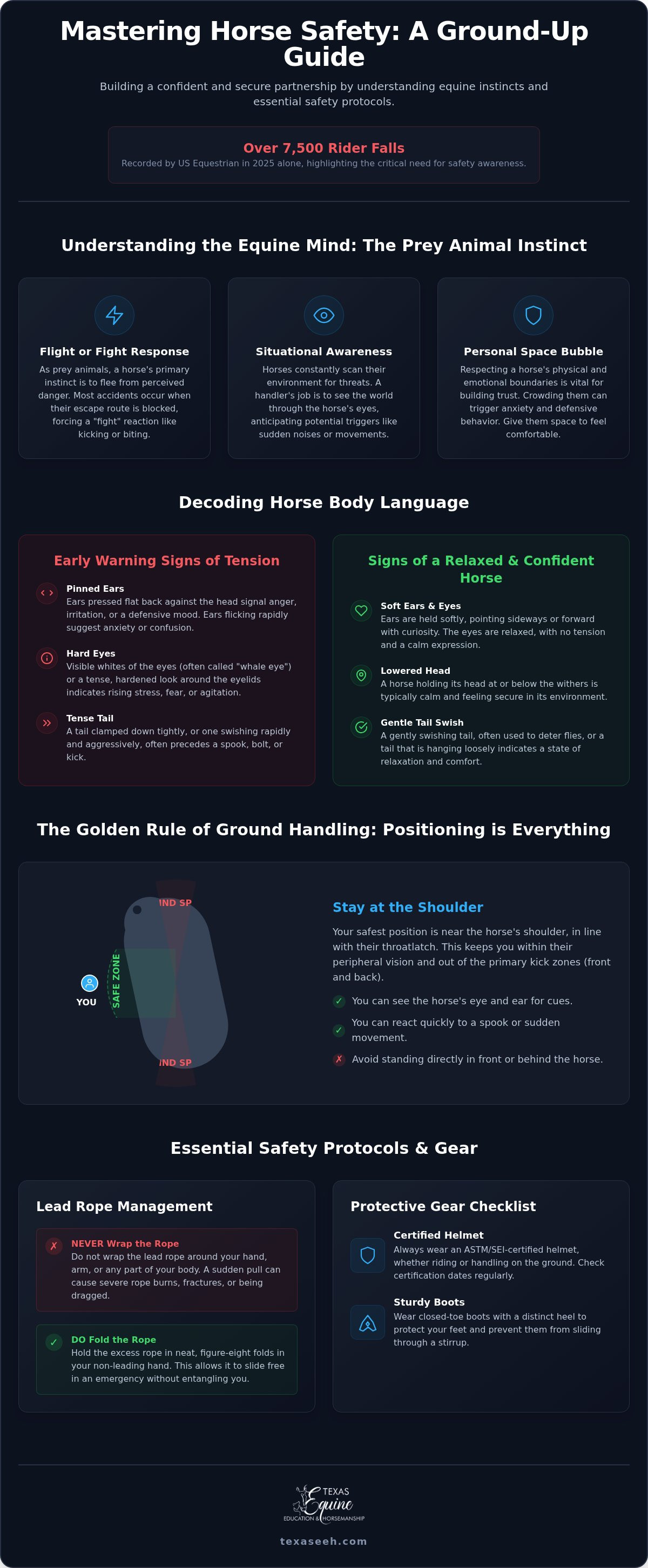
To truly master horse safety, you must first understand that horses are prey animals. Their entire psychology is built around detecting and escaping threats. This survival instinct dictates how they react to sudden movements or unfamiliar sounds. According to the principles of Equitation Science, understanding these biological drivers is the first step in creating a predictable and peaceful environment.
The flight or fight response is the horse's primary defense mechanism. Since they're designed to run from danger, a horse that feels startled or cornered will almost always choose flight first. Most common accidents occur when a handler inadvertently blocks a horse's escape route or ignores the tension building in their body. Recognizing this instinct allows you to stay calm and provide the horse with the reassurance they need to stay grounded.
Every horse has a personal space bubble, and respecting this boundary is vital for mutual trust. Just as you require space to feel comfortable, a horse needs to know you won't crowd their physical or emotional limits. Equine situational awareness is the handler's ability to monitor the environment through the horse's eyes.
Interpreting Horse Body Language and Silent Communication
Horses communicate through subtle physical cues long before they react. Watch for these early warning signs:
Ears: Pinning flat back suggests anger or defense, while ears flicking rapidly indicate confusion.
Eyes: Visible whites or a hardened look around the eyelids signal rising stress.
Tail: Rapid swishing or a clamped tail often precedes a spook or a kick.
A relaxed horse will show a soft eye and a lowered head, signaling they feel secure. Recognizing these shifts from tranquility to tension is a skill developed over time that directly impacts horse safety. For those looking to deepen their understanding, exploring a foundational horsemanship course provides a structured way to study these behavioral patterns in detail.
Practical Ground Handling and Essential Safety Protocols
Physical positioning is the foundation of horse safety. The "Golden Rule" of handling is to stay near the horse's shoulder. This position keeps you out of their blind spots, which are located directly in front of their nose and directly behind their tail. When you stand at the shoulder, you remain in their peripheral vision, which significantly reduces the chance of startling them. For more details on these techniques, you can review this safe horse handling guide.
Proper lead rope management is just as critical for your security. You should never wrap a lead rope around your hand, arm, or waist. If a horse suddenly pulls away or bolts, a wrapped rope can cause severe injury. Instead, fold the excess rope in a figure-eight pattern in your non-leading hand. This allows the rope to slide free if the horse makes an unexpected move. As noted in resources regarding Safe Horse Handling, maintaining this type of controlled grip ensures you can release the horse quickly in an emergency.
Your choice of equipment provides a vital layer of protection. Always use a helmet that meets current ASTM/SEI certification standards. For 2026, riders are increasingly seeking gear that exceeds basic standards for impact management. Pair your helmet with sturdy, closed-toe boots that feature a distinct heel to prevent your foot from sliding through a stirrup.
Safe Leading and Grooming Techniques for Beginners
When entering a stall, speak softly to alert the horse of your presence before opening the door. Approach the shoulder calmly and slip the lead rope over their neck before sliding the halter into place. During grooming, maintain a hand on the horse to let them know where you are. When moving around the hindquarters, either stay very close to the body with your hand on the rump or walk wide enough to be completely out of kicking range. Practicing these skills in ground work horse training classes builds the muscle memory needed for a secure partnership.
Building a Culture of Safety Through Horsemanship Education
True horse safety isn't a destination but a continuous journey of learning. Many riders feel eager to jump into the saddle, yet the most critical safety investment you can make happens on the ground. Engaging in non-riding horse education provides the psychological and physical framework needed to handle horses with confidence. This specialized knowledge allows you to understand the "why" behind an animal's reactions, transforming fear into informed respect. Without this foundation, handlers often miss the subtle cues that signal a horse's discomfort or rising anxiety.
Professional mentorship plays a vital role in this process. A seasoned mentor identifies risks that a beginner might overlook, such as a slightly loose cinch or a tense jaw. This guidance is especially important as you progress. Statistics from organizations like US Equestrian suggest that accidents often occur when a rider becomes too comfortable. Consistent education prevents this complacency, keeping your awareness sharp as you refine your horsemanship skills over time. It's about staying curious and humble in the presence of these powerful animals.
The Role of Foundational Knowledge in Risk Mitigation
Understanding tack fit and equine health is a safety requirement rather than an optional skill. A horse in pain from a poorly fitted saddle is more likely to react unpredictably. By learning essential safety protocols for handling horses, you create an environment where the horse feels physically and emotionally supported. Structured equine care classes help build this handler confidence and reinforce long-term horse safety through hands-on experience and clear instruction. At Texas Equine™, we believe that every equestrian's success starts from the ground up through comprehensive horsemanship and equine care education.
Embracing a Journey of Confident Horsemanship
Building a secure partnership with horses is a rewarding process that begins with a deep respect for their natural instincts. By prioritizing the principles discussed, from understanding prey animal psychology to mastering safe positioning, you transform your interactions into a meaningful dialogue of trust. Maintaining this awareness throughout your life ensures that horse safety remains a constant priority, protecting both you and your equine companion from the risks of complacency. Every step taken on the ground strengthens your readiness for the saddle. To support this journey, Texas Equine Education & Horsemanship™ provides an education-first approach through national learning programs and certified equine industry readiness standards. Ready to build your foundation? Explore Horsemanship and Equine Care Education at Texas Equine™. Your journey toward a holistic bond is a path of lifelong discovery and steady growth.
Frequently Asked Questions
What is the most important horse safety rule for beginners?
The most important rule for beginners is to prioritize ground-up education before ever entering the saddle. Understanding that horses are prey animals helps you stay aware of their natural instincts and flight responses. Always maintain a safe position by the horse's shoulder to stay within their peripheral vision. This practice is a cornerstone of horse safety because it prevents you from being in a blind spot.
How can I tell if a horse is about to kick or bite?
You can predict these actions by carefully observing a horse's subtle body language. A horse about to kick will often pin its ears flat back, swish its tail aggressively, or shift its weight to lift a hind leg. Signs of a potential bite include baring teeth, snaking the neck, or flattening the ears. Recognizing these early warnings allows you to step back and calmly reassess.
Why do I need a specific equestrian helmet instead of a bike helmet?
Equestrian helmets are specifically designed and tested to withstand the unique impacts of horse-related accidents. Unlike bike helmets, which are built for forward-motion falls on pavement, riding helmets provide protection for falls from height and potential strikes from a hoof. Always look for the latest ASTM/SEI certification to ensure your gear meets the rigorous standards required for horse safety in 2026.
Is it safe for children to handle horses on the ground?
It's safe for children to handle horses provided they have professional supervision and age-appropriate education. Starting with foundational horsemanship helps young learners respect the animal's size while building their own confidence. Specialized sessions like Tiny Tot lessons focus on teaching kids how to move calmly and intentionally. This structured approach ensures that children develop a lifelong bond with equine companions based on mutual security and respect.


Comments