


Mastering Horse and Rider Communication: A Practical Guide

What if the cue your horse seems to ignore isn't defiance, but quiet confusion? True horse and rider communication is a responsive dialogue of subtle pressure and release, never an exercise in mechanical force. It's deeply frustrating when your horse leans on the bit or hesitates to move off your leg, leaving you anxious about pulling harder just to be heard. You want a willing, calm partner who listens without tension, yet mixed signals often cloud the conversation.
In this guide, you'll discover how horses interpret subtle aids and learn how to deliver soft, clear signals with steady balance and timing. We'll explore how to recognize early equine feedback, refine your seat and hands, and build a relaxed partnership that transfers seamlessly from groundwork to the saddle.
Table of Contents
Understanding Horse and Rider Communication as a Two-Way Dialogue
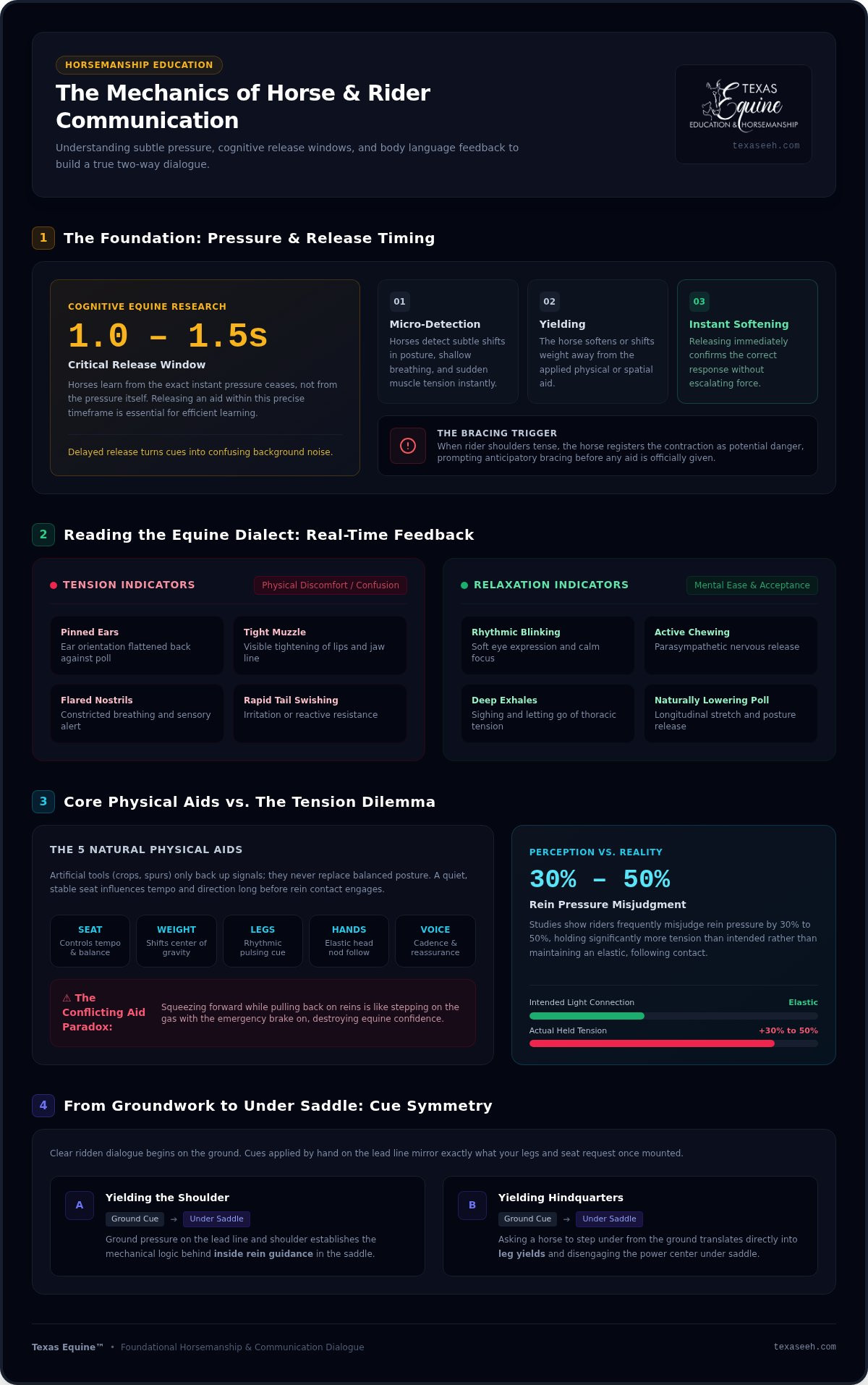
Effective horse and rider communication is a living conversation, not a series of one-way commands. Because horses evolved as prey animals, their survival depended on detecting micro-movements in their herd and surroundings. They perceive minute shifts in your posture, shallow breathing, and sudden muscle tension the moment you take the lead or step into the stirrup. When you tense your shoulders, your horse registers that contraction as potential danger, bracing before you even apply an aid.
At the center of this sensory exchange lies the principle of pressure and release. Horses learn from the exact instant pressure ceases, not from the pressure itself. According to cognitive equine research, releasing an aid within 1.0 to 1.5 seconds of a correct response is essential for efficient learning. If you hold pressure after the horse yields, the cue becomes confusing background noise rather than guidance.
Interpreting Subtle Equine Body Language Cues
Learning your partner's visual dialect allows you to adjust your requests before resistance takes root. Watch for real-time feedback during every session:
Tension indicators: Pinned ears, a tight muzzle, flared nostrils, or rapid tail swishing signal physical discomfort or confusion.
Relaxation indicators: Soft, rhythmic blinking, active chewing, deep exhales, and a naturally lowering poll show mental ease and acceptance.
Tuning in to these silent expressions is central to building trust with horses during early interactions. When you acknowledge their feedback by softening your aids, your horse feels heard, laying a dependable foundation for genuine partnership.
Applying the Core Physical Aids with Balance and Feel
True clarity in horse and rider communication relies on your natural aids: seat, weight, legs, hands, and voice. Artificial tools like crops or spurs only back up these signals; they never replace balanced posture. When you subtly shift your weight, your horse instinctively adjusts their center of gravity to stay underneath you. A quiet, stable seat influences tempo and direction long before rein contact engages. Problems arise when riders deliver conflicting aids simultaneously, such as squeezing forward while pulling back on the reins. Stepping on the accelerator while pulling the emergency brake erodes your horse's confidence and creates defensive tension.
Refining Hand and Leg Coordination to Eliminate Mixed Signals
Maintaining an independent seat allows your hands to remain soft and responsive. Studies show riders frequently misjudge rein pressure by 30% to 50%, often holding far more tension than intended. Aim for an elastic contact that follows the natural nod of the horse's head, requiring only a light connection rather than restrictive force. Similarly, leg aids should offer a clear, rhythmic pulse that softens the instant your horse responds.
Integrating core horsemanship skills helps you isolate muscle groups, preventing unintended bracing. For riders working to refine their seat and feel, seeking out structured horsemanship lessons provides the objective feedback needed to master this quiet balance.
Developing Consistent Cues from Groundwork to Under Saddle
Clear ridden dialogue rarely begins in the saddle; it starts on the ground. Before mounting, working on the lead line establishes respectful personal space and consistent vocal cues that carry directly into your riding. When you ask a horse to yield their shoulder or step under with their hindquarters from the ground, you introduce the mechanical logic behind inside rein guidance and leg yields. Clear horse and rider communication thrives when the cues you apply by hand mirror what your legs and seat request under saddle.
Structured Education to Support Lifelong Human-Horse Partnerships
Advancing this dialogue requires patience and methodical consistency rather than rushed results. Rushing a horse through unfamiliar exercises creates tension, whereas steady repetition gives them space to process new expectations. Participating in structured ground work horse training classes helps handlers isolate physical cues and refine their timing before swinging a leg over the saddle.
To support a calm, confident transition from handling to riding, Texas Equine™ cultivates mutual understanding through a dedicated foundational horsemanship course. By focusing on a step-by-step progression, handlers and riders master the clear horse and rider communication needed to foster a lasting, cooperative partnership.
Transforming Your Ridden Conversation Step by Step
True harmony in the arena is never about physical dominance. When you cultivate quiet seat balance, release pressure with precise timing, and listen to subtle behavioral feedback, horse and rider communication transforms into an effortless exchange. Groundwork establishes this predictable foundation, ensuring your cues remain consistent whether you're working on the lead line or sitting in the saddle.
Progress in horsemanship is a steady, rewarding journey built on patience and feel. With an education-first foundational curriculum and an accessible nationwide approach to learning, riders of all experience levels can develop genuine self-assurance. Discover the educational programs offered by Texas Equine™ to build clear dialogue and quiet confidence ground-up. Every soft, intentional aid brings you closer to the willing partnership you both deserve.
Frequently Asked Questions
What are the natural aids used in horse and rider communication?
Natural aids are the physical tools you were born with: your seat, legs, hands, weight, and voice. In effective horse and rider communication, these elements work in unison to shape direction and impulsion. Your seat guides rhythm, your legs encourage forward movement or lateral steps, your hands maintain a soft connection, and calm vocal tones reinforce steady downward transitions.
How do horses sense rider anxiety or tension in the saddle?
Horses detect anxiety through rider posture, restricted breathing, and involuntary muscle contractions along your back and thighs. Because horses naturally synchronize with herd members, a rider holding their breath feels like an alert to nearby danger. This physical rigidity stiffens the saddle area, prompting the horse to mirror that tension with raised posture, choppy strides, and nervous energy.
Why is the release of pressure more important than the pressure itself?
The release of pressure is the actual teaching moment because it rewards the horse for finding the correct answer. Pressure merely poses a physical question; softening that aid confirms they made the right choice. If pressure continues after your horse yields, they cannot identify the desired behavior. Prompt, intentional releases foster clarity, encouraging your horse to seek softness rather than resistance.
How does ground training translate to communication while riding?
Ground training establishes a shared mechanical vocabulary while building trust without the balance demands of carrying a rider. Teaching a horse to yield their shoulders, back up softly, or halt from verbal cues creates clear mental patterns. When you ask for identical movements under saddle, your horse already recognizes the concept, making ridden horse and rider communication smooth and predictable.


Comments