


Equine Industry Career Preparation: Mastering the Barn Manager Role
- Kim Williams

- 3 days ago
- 6 min read
What if the most vital skill for a successful stable isn't your ability to clear a jump, but your capacity to manage a complex ecosystem of care? It's completely natural to feel uncertain when transitioning from a passionate rider to a professional leader. You might worry that your years in the stirrups haven't fully prepared you for the logistical weight of daily operations or the nuances of modern certifications. This transition is a journey that deserves a patient and supportive guide to help you find your footing.
This article provides a clear roadmap for equine industry career preparation, helping you master the barn manager role with confidence. We'll explore the specific daily responsibilities required for success, the certifications that truly matter, and how professional pathways like the Equine Industry Readiness Program™ can bridge the gap between your love for horses and a thriving, sustainable career.
Table of Contents
The Equine Barn Manager Job Description: Core Responsibilities and Operations
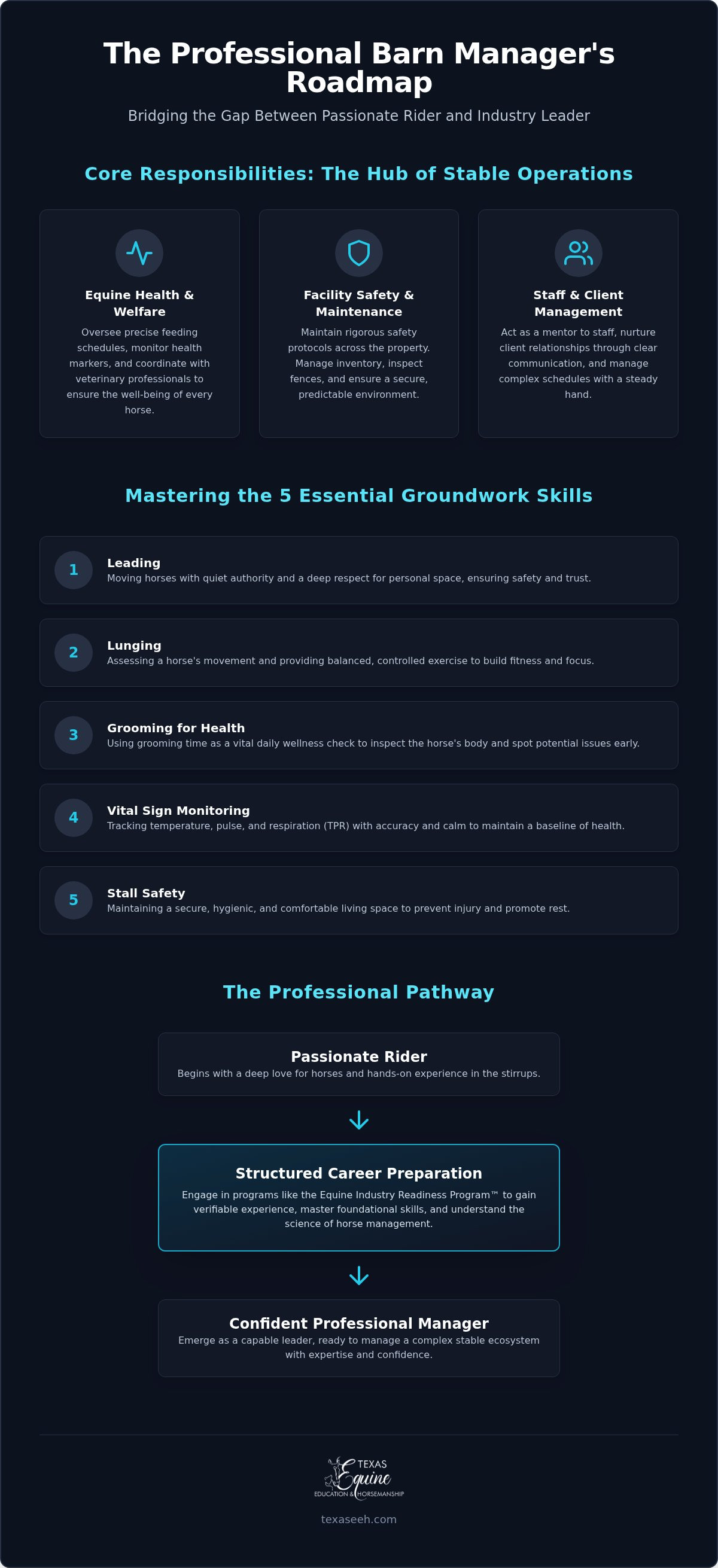
A barn manager serves as the central coordinator for a stable's daily life, overseeing the vital intersection of equine health, facility maintenance, and personnel management. This role requires a steady hand and a deep commitment to the well-being of every horse in your care. Your daily duties will involve a methodical rhythm that keeps the environment safe and predictable. Effective equine industry career preparation focuses on this balance of administrative tasks and hands-on welfare. You'll find yourself managing inventory and complex schedules while remaining grounded in the physical needs of the animals. Ultimately, the barn manager role is the bridge between equine science and practical stable logistics.
Mastering horse management means understanding that every detail matters. Whether you're inspecting fences or reviewing a veterinarian's report, your presence ensures stability for the entire community. It's a journey of constant learning where your expertise builds a foundation of trust for both the horses and their owners. Common daily operations include:
Overseeing precise feeding and nutrition schedules for each individual horse.
Monitoring equine health markers and coordinating with veterinary professionals.
Maintaining rigorous safety protocols and facility maintenance standards across the property.
Essential Soft Skills and Leadership in Stable Management
Success in this field relies heavily on your ability to connect with others. Clear, supportive communication is vital when you're managing staff, coordinating with veterinarians, or nurturing client relationships. Because horses and weather are naturally unpredictable, you must develop a calm sense of adaptability and creative problem-solving. True leadership in a stable environment involves acting as a patient mentor to grooms and handlers. By teaching others to maintain high equine health and care standards, you create a culture of excellence and emotional safety that benefits everyone involved.
Foundational Knowledge: Essential Equine Industry Career Preparation
True professional expertise is built from the ground up. Mastering foundational horsemanship serves as the essential bedrock for any leadership role in a stable. Management positions require a deep, intuitive understanding of equine behavior, anatomy, and nutrition. These core subjects empower you to make informed daily care decisions that prioritize the horses' long-term health and emotional well-being. Safety is the non-negotiable cornerstone of equine industry career preparation. It requires standardized handling techniques for every interaction to ensure a peaceful and secure environment. You can start this journey by exploring our professional internships designed to build your confidence through step-by-step learning.
Every aspiring manager must master five essential groundwork skills:
Leading: Moving horses with quiet authority and respect for personal space.
Lunging: Assessing movement and providing balanced exercise in a controlled manner.
Grooming for health: Inspecting the horse's body as a vital daily wellness check.
Vital sign monitoring: Tracking temperature, pulse, and respiration with accuracy and calm.
Stall safety: Maintaining a secure, hygienic living space to prevent injury and promote comfort.
Mastering Ground-Up Horse Handling and Care Standards
Ground handling mastery ensures the safety of both the horse and the handler in high-pressure environments. Understanding daily care fundamentals, from hoof health to digestive wellness, allows a manager to spot potential issues before they become crises. Professional readiness involves learning to implement standardized routines that ensure consistency across large-scale operations. This methodical approach creates a sense of stability and tranquility within the barn. By focusing on these building blocks, you transition into a grounded leader who values the relationship between the individual horse and their surroundings.
Professional Pathways: Equine Industry Readiness and Certification
Building a successful career in this field is a journey that requires both heart and verifiable proof of your abilities. Modern equine careers often benefit from professional equine career readiness programs that offer structured, hands-on experience. These programs provide the stability you need to grow your skills in a safe and supportive environment. Certification acts as a standardized proof of skill, helping you stand out in a competitive job market by showing you've met industry-recognized standards. Flexibility is vital for students who are balancing academic schedules with their practical skill development. Modular internship segments allow for deep focus on specific management areas without overwhelming the learner, making your progress feel methodical and steady.
Leveraging Internships for Practical Career Advancement
Internships provide the vital lab time necessary to apply theoretical knowledge to real-world stable scenarios. They act as a bridge between classroom learning and the physical demands of the barn, allowing you to practice in a controlled, mentored setting. The Equine Industry Readiness Program™ by Texas Equine™ offers 8-week internship certification segments specifically designed to fit into a university schedule. This modular approach respects your existing commitments while prioritizing your professional development. Completing these modules, whether you do them consecutively or over several semesters, builds a comprehensive portfolio of internships. This collection of experience demonstrates a long-term commitment to the field and a readiness to lead with quiet authority. Your equine industry career preparation becomes a series of intentional, empowering steps that build your confidence as a future barn manager.
Embarking on Your Professional Management Journey
Mastering the barn manager role is a rewarding process that transforms your passion into a structured professional path. By focusing on a ground-up educational philosophy, you develop the stability and confidence needed to oversee complex stable operations. We've explored how essential groundwork and clear communication act as the pillars of success in this field. This thoughtful approach to equine industry career preparation ensures you're ready for the physical and logistical demands of the modern barn. Whether you're a student or an adult seeking a new direction, professional development is accessible for all ages. You can take the next step in your growth by exploring our 8-week modular internship segments. Learn more about building your career with the Equine Industry Readiness Program™ at Texas Equine™. Your journey toward a peaceful and fulfilling career starts with a single intentional step.
Frequently Asked Questions
Do I need a college degree to become a barn manager?
No, a college degree isn't strictly required to become a barn manager. While some high-end facilities appreciate related degrees, the industry often prioritizes hands-on experience and specialized certifications. Focusing on practical equine industry career preparation through programs like our modular internships can provide the verifiable skills employers value most. This ground-up approach builds the confidence and technical knowledge needed for professional leadership without requiring a four-year degree.
What is the average salary for an equine barn manager in 2026?
Average salaries for barn managers in 2026 vary based on facility size and location. Current industry reports show a wide range; some sources list averages around $37,754 annually, while others report figures reaching $72,360 for senior management roles. Compensation often includes unique benefits like housing or stall board. Your experience level and specialized certifications play a significant role in determining your earning potential within this professional field.
How long does it take to complete an equine industry certification?
The timeline depends on the specific program you choose. For instance, the Equine Industry Readiness Program™ uses flexible 8-week modular internship segments. This structure allows you to complete your certification consecutively or over several terms to accommodate your personal schedule. This methodical pace ensures you have enough time to absorb foundational concepts and practice hands-on skills until they become second nature and build your confidence.
Can I start career preparation if I have limited horse experience?
Yes, you can absolutely begin your journey with limited experience. We believe in an education-first approach that starts from the ground up. By enrolling in foundational equine care classes and horsemanship lessons, you'll build a safe and steady relationship with horses. This step-by-step process ensures your equine industry career preparation is thorough. It helps you develop the quiet authority and technical skills needed for future management roles.


Comments