


Equine Professional Development: A Guide to Career Growth in the Horse Industry
- Kim Williams

- 4 hours ago
- 6 min read
Loving horses is the heartbeat of your career, but it isn't the finish line for professional success. Many of us start with a deep passion only to feel lost when trying to turn that connection into a sustainable livelihood. It's common to feel overwhelmed by the choice between clinical certifications and recreational programs; or to worry that a degree won't provide the hands-on experience you need for the barn. True equine professional development is about more than just collecting certificates. It's a steady process of building the confidence and practical skills that employers actually value.
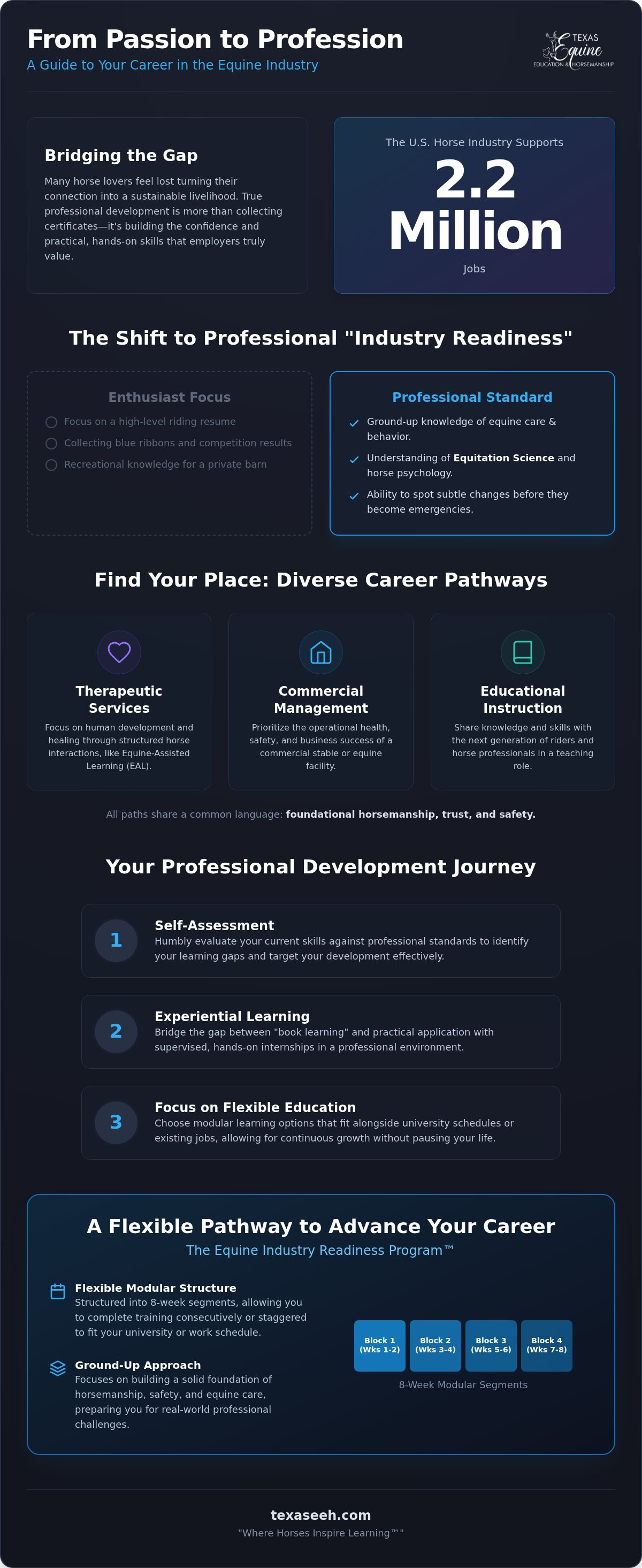
In this guide, you'll discover how to bridge the gap between passion and expertise through structured horsemanship education. We'll explore how flexible learning modules and a focus on industry readiness can help you find your place in an industry that supports 2.2 million jobs. By focusing on the why behind every interaction, you can transform your love for horses into a rewarding career.
Table of Contents
Navigating the Pathways of Equine Professional Development
Equine professional development is a lifelong commitment to refining your horsemanship and aligning with modern industry standards. It isn't just about learning to ride; it's about understanding the horse as a partner in a professional setting. This growth often spans three primary sectors: therapeutic services, commercial barn management, and educational instruction. Each path requires a different set of tools, but they all share a foundation of respect for the animal's well-being.
The industry is evolving. Today, employers look for "Industry Readiness" rather than just a high-level riding resume. Professionals who understand Equitation Science and the psychological needs of the horse are in high demand. This scientific approach to training and welfare ensures that professionals can provide stable, reliable care across any discipline. With the U.S. horse industry supporting 2.2 million jobs, having a solid educational foundation is more important than ever. Many students find that hands-on internships help build this essential expertise.
Instructor Insight:
You might have a wall of blue ribbons, but a barn manager needs to know you can spot a slight change in a horse's behavior before it becomes a medical emergency. Ground-up knowledge of equine care and behavior is often more valuable to a team than a riding resume because it ensures the safety and stability of the entire facility.
Beyond the Saddle: Understanding Diverse Career Sectors
Career paths vary widely. Equine-assisted learning (EAL) focuses on human development through horse interactions, while traditional barn management prioritizes the operational health of a commercial facility. Despite these differences, foundational horsemanship remains the common language. Whether you are teaching a child or managing a high-end stable, the principles of trust and safety are the same. To find your specific path, you can explore resources on Choosing the Right Equine Industry Certification Program to see which standards align with your long-term goals.
Evaluating Your Professional Growth: Skills, Standards, and Certifications
Assessing your current skills is the first step in any journey of equine professional development. It begins with a humble look at your ground-handling and equine care proficiency. While you might feel comfortable in your own barn, professional industry standards often require a higher level of precision and consistency. Identifying this gap between recreational knowledge and workplace expectations allows you to target your learning effectively. This self-assessment ensures you're building on a solid foundation rather than skipping ahead to specialized certifications before you're ready.
Choosing a path doesn't have to mean pausing your life. Many aspiring professionals look for modular, flexible learning options that fit alongside university schedules or existing jobs. For those seeking formal academic pathways, the University of Kentucky Equine Programs offer a comprehensive look at equine science and management. As you learn, focus on building a professional portfolio. A well-rounded portfolio acts as a bridge in your equine professional development, showing potential employers that you possess both the theoretical knowledge and the discipline required for the job.
The Role of Experiential Learning and Internships
"Book learning" provides a necessary foundation, but it's insufficient without supervised, hands-on application in a professional environment. Internships bridge this gap, offering college students a chance to earn credit while gaining the tangible skills employers prioritize. When working in public or educational settings, following professional-grade safety protocols is essential. This protects both the horse and the handler, ensuring a stable environment for learning. Understanding these protocols is a hallmark of a true professional. If you're ready to move from theory to practice, you can explore additional educational resources through structured internship segments.
Advancing Your Career with the Equine Industry Readiness Program™
The Equine Industry Readiness Program™ provides a flexible pathway for students and career-seekers who need to balance their education with practical experience. It's structured into 8-week modular segments, allowing you to complete your training consecutively or stagger the blocks to fit your university schedule. This modularity ensures your equine professional development stays on track without the pressure of a rigid, year-long commitment. It's about meeting you where you are in your journey.
By focusing on a ground-up approach, the program prepares you for meaningful milestones like the Horse & Rider Showcase™. These events aren't just about performance; they're an opportunity to demonstrate the stability and trust you've built with the horse. This level of readiness proves to future employers that you understand the "why" behind every interaction. It shows you've moved beyond basic riding to true horsemanship.
Texas Equine Tip:
Keep a learning journal as you progress through your segments. Tracking the evolution of your horsemanship philosophy helps you see how your perspective on horse behavior and safety matures over time.
Integrating Virtual Learning into Professional Practice
Continuous learning doesn't always require you to be at the barn. Weekly virtual education sessions offer a way to maintain your equine professional development regardless of your location. These sessions help bridge the gap between physical practice and theoretical understanding. For instance, the UC Davis Equine Welfare Course provides deep insights into management that complement your hands-on work. You can explore additional Virtual Education opportunities to begin refining your skills remotely. Participating in online horse shows also helps you practice professional presentation and evaluation, ensuring you're ready for the spotlight when it arrives.
Your Future in the Horse Industry
Building a career with horses is a path that requires patience, dedication, and a commitment to continuous learning. By prioritizing an education-first approach, you ensure that your skills are rooted in safety and deep horsemanship. We've explored how understanding industry standards and refining your ground-handling skills sets you apart in a competitive field. For university students and aspiring professionals alike, your equine professional development should be as flexible as your schedule.
Our modular 8-week certification segments allow you to grow at your own pace while making a nationwide literacy and education impact through programs like The Reading Rein™. Continue your learning by exploring our Equine Industry Readiness Program™. You have the passion to succeed, and with the right tools, you can build a stable and fulfilling career where horses truly inspire learning.
Frequently Asked Questions
What is equine professional development and why is it important?
Equine professional development is the intentional process of building expertise through horsemanship education and industry readiness. It's important because it creates a standard of safety and excellence that protects both the horse and the handler. By focusing on ground-up knowledge, professionals can ensure they have the stability and confidence needed to succeed in a variety of roles across the horse industry.
How long does it take to complete an equine industry certification?
The timeline for certification varies depending on the specific program and your existing experience levels. For those seeking flexibility, the Equine Industry Readiness Program™ offers 8-week internship certification segments. These modules can be completed consecutively or staggered over time to accommodate university schedules or other life commitments. This approach allows you to learn at a pace that ensures you truly master each foundational skill.
Can I earn college credit for equine internships?
Many university students successfully earn college credit by participating in structured equine internships. These programs provide the hands-on application that classroom learning often lacks, bridging the gap between theory and the professional workplace. It's best to coordinate with your academic advisor to ensure the internship segments align with your specific degree requirements and meet the standards for experiential learning credits.
What is the difference between a horse riding instructor and an equine specialist?
A horse riding instructor primarily focuses on teaching equitation, riding styles, and technical skills in the saddle. In contrast, an equine specialist often works in fields like equine-assisted learning, focusing on horse behavior, ground-handling, and the horse-human relationship. Both roles require deep horsemanship knowledge, but the specialist prioritizes the horse’s psychological well-being and its role as a partner in human development and education.


Comments