


Equine Art Show: Creative Fun for Every Horse Lover

You don't have to be a professional artist—or even consider yourself an artist—to create something meaningful inspired by horses.
Horse people spend countless hours noticing the little things: the curve of a horse's neck, the expression in an eye, the movement of a mane, the colors hidden within a coat, or the personality that makes one horse completely different from another. Art gives us another way to capture those details and celebrate the animals that mean so much to us.
That is the idea behind the Equine Expression & Heritage Art Show™ at Texas Equine Education & Horsemanship™.
From fun art to fine art, the show welcomes creativity in its many forms. Paintings, drawings, photography, sculpture, crafts, mixed media, digital creations, and other horse-inspired works all have a place. Children can participate. Adults can participate. Experienced artists can participate. So can someone picking up a box of colored pencils for the first time in years.
Because at Texas Equine™, we believe horses can inspire learning almost anywhere—including at the art table.
Table of Contents
Celebrating Equine Expression: An Art Show for Every Horse Lover
For centuries, people have used art to document their relationship with horses. Horses appear in ancient artwork, paintings, sculpture, photography, literature, folk art, and countless traditional crafts.
That relationship continues today.
The Equine Expression & Heritage Art Show™ gives today's horse lovers an opportunity to add their own voices to that long creative tradition.
You might be an experienced equestrian who wants to paint a favorite lesson horse. You might be a photographer fascinated by horses in motion. You might be a child who simply loves drawing ponies. You might enjoy woodworking, sewing, leatherwork, sculpture, digital art, or crafts and decide to make something with an equine theme.
All of those perspectives can tell a story.
At Texas Equine™, we don't believe meaningful equine art has to begin in a professional studio. Sometimes it begins at a kitchen table with construction paper, glue, and crayons.
The Purpose of the Heritage Art Show
The Art Show grew from a simple idea: horses inspire creativity as naturally as they inspire learning.
Throughout history, horses have played important roles in agriculture, transportation, sport, military history, ranching, recreation, and companionship. Art has helped preserve those stories and document the changing relationship between horses and people.
Horses have been central figures in our cultural narrative for centuries. Exploring the history of horses in art shows us that humans have always used creative mediums to document their respect for these creatures. This show continues that legacy by acting as a national community gathering for horse lovers. It's a place to celebrate the heritage we share and the individual growth we experience through our equine partnerships.
The Equine Expression & Heritage Art Show continues that tradition while making room for today's horse lovers to interpret the horse in their own ways.
Some pieces may celebrate equine history or traditional horsemanship. Others may capture a beloved horse's personality. Some may be technically sophisticated works created by experienced artists, while others may simply be joyful expressions of someone's love for horses.
That's why we like to think of the show as a place for fun art to fine art.
Why Hobbyists and Crafters Belong Here
One of the biggest barriers to entering an art show can simply be the word art.
People often hear "art show," and immediately picture framed oil paintings hanging in a gallery.
But creativity is much broader than that.
Maybe you decorate horseshoes. Maybe you crochet horses. Maybe you make collages, paint rocks, create jewelry, sculpt with clay, draw cartoons, work with textiles, or turn recycled materials into something completely unexpected.
That creativity counts.
Children shouldn't have to create like adults, beginners shouldn't have to create like professionals, and crafters shouldn't have to become traditional painters to participate in creative spaces.
The goal is to encourage people to explore the horse through whatever medium inspires them.
Many people hesitate to share their work because they don't see themselves as "artists." We prefer to think of art as creative storytelling. If you've ever decoupaged a photo of your first pony or braided a keepsake from a mane, you're already an artist in our eyes. This equine art show is designed to be family-friendly and open to all ages, ensuring that a child's crayon drawing is valued alongside a professional's sculpture.
Texas Equine™ Tip: Don't wait until you think you're "good enough" to create something. Art, like horsemanship or learning an instrument at StringTheory6, develops through practice, experimentation, observation, and a willingness to keep learning.
From Traditional Crafts to Fine Art: Exploring Your Creative Mediums
One of the best things about equine art is the enormous variety of ways horses can be represented.
A single horse could inspire a watercolor painting, a graphite portrait, a photograph, a clay sculpture, a quilt square, a digital illustration, or a piece made from repurposed barn materials.
There is no single correct way to create horse art.
The Spectrum of Creative Mediums
Participants might choose to experiment with mediums such as:
Drawing: graphite, charcoal, colored pencil, crayons, markers, ink, or pastels.
Painting: watercolor, acrylic, oil, tempera, or other painting techniques.
Sculpture: clay, papier-mâché, wood, wire, or other three-dimensional materials.
Photography: portraits, action photographs, detail studies, silhouettes, or images documenting the horse-human relationship.
Heritage Crafts: leatherwork, textiles, sewing, weaving, embroidery, or horse-inspired traditional crafts.
Mixed Media: combining paint, paper, fabric, photographs, natural materials, or other textures.
Digital Art: illustrations and original artwork created using digital tools.
Creative Crafts: imaginative horse-themed projects that may not fit neatly into a traditional fine-art category.
The medium is simply the tool you use to tell your story.
In the ancient world, horses were frequently depicted as symbols of wealth and status. While that historical weight remains, your "fun art" transitions into "fine art" the moment you use your medium to communicate a specific feeling or lesson learned from your horse. Don't be afraid to use unconventional materials like clean horsehair or old tack to add a tactile element to your work.
Horse Talk: Understanding Art Terms for Beginners
If you're new to art, don't let unfamiliar terminology intimidate you. A few basic terms can make exploring different mediums easier.
Medium: The material or technique used to create the artwork, such as watercolor, clay, photography, or colored pencil.
Composition: How the different elements are arranged within the artwork.
Subject: The main focus of the piece. Your subject might be a specific horse, a herd, a rider and horse together, a piece of tack, or another element of equine life.
Mixed Media: Artwork created by combining more than one material or artistic technique.
Equine Heritage: The traditions, history, culture, work, sport, and relationships that have shaped the role of horses in human life.
You don't have to memorize art vocabulary before creating something. The terminology simply gives us ways to talk about what we're making.
Every piece submitted helps us build a richer picture of what it means to live with horses today. You can view our current show categories to see where your creative project might fit best.
A Quick Safety Note
If your creative project takes you into the barn or pasture, remember that art supplies and horses aren't always a great combination.
Keep paint, glue, small craft materials, sharp tools, and other supplies safely away from curious noses and mouths. If a horse is part of your creative process, equine safety should always come before getting the perfect photograph, sketch, or reference image.
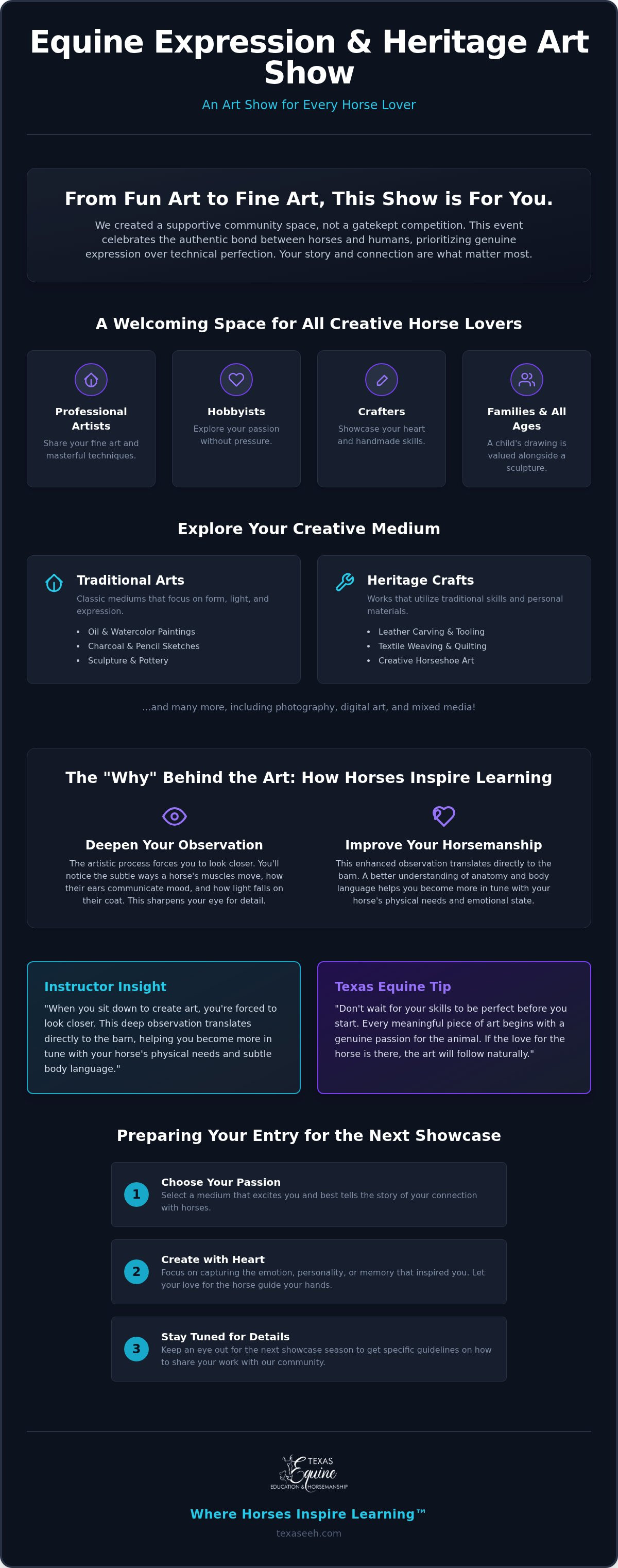
The "Why" Behind the Art: How Horses Inspire Learning
At Texas Equine Education & Horsemanship, our philosophy is Where Horses Inspire Learning™.
That learning doesn't have to stop when someone leaves the arena.
Art can encourage us to slow down and look at horses differently.
Think about what happens when you try to draw a horse's face. Suddenly, you start noticing where the eyes actually sit, how the ears attach to the poll, how the cheek changes shape, and how much expression can be communicated through tiny differences in posture.
Try to paint a horse's coat, and you may discover that a "brown horse" isn't simply brown at all. There may be gold, black, red, gray, cream, and dozens of subtle variations created by light and shadow.
Try photographing horses, and you'll quickly begin paying attention to movement, balance, expression, and timing.
The creative process encourages observation—and careful observation is also an important part of horsemanship.
When we sit down to sketch or craft, we engage in a level of active observation that is often missed during a busy day at the barn. This process aligns perfectly with the principles in our Foundational Horsemanship Course, where we emphasize learning from the ground up. By translating a horse's physical presence into a creative medium, you're essentially studying their essence.
We've seen firsthand how from fun art to fine art - the Equine Expression & Heritage Art Show is for andyone who love horses even if they are not professional artists. people who like to craft find that the creative process builds a bridge between their technical knowledge and their emotional connection to the herd. This act of creation has a profound therapeutic effect, slowing the heart rate and encouraging a state of mindfulness similar to the tranquility found in a quiet grooming session.
Learning Anatomy and Behavior Through Art
Ask someone to draw a horse from memory, and you'll quickly discover just how complicated horses really are!
Their proportions are surprisingly difficult to reproduce.
Where does the hock actually bend? How long is the cannon bone compared with the forearm? Where do the withers sit? How does the neck connect to the shoulder?
Drawing, painting, and sculpting can encourage learners to look more closely at equine anatomy rather than simply memorizing vocabulary.
Young learners, in particular, can use art projects to reinforce concepts such as:
identifying parts of the horse;
recognizing coat colors and markings;
comparing breeds and body types;
observing movement and posture; and
noticing differences in facial expressions and body language.
A child drawing a horse may not realize they're studying anatomy—but learning doesn't always have to look like a worksheet.
Organizations like the Foundation for the Equestrian Arts emphasize this intersection of study and appreciation, proving that artistic focus builds better horsemen.
Instructor Insight: Artists often develop a "keen eye" for subtle behavioral cues. By spending hours looking at a subject to capture its likeness, you'll start to notice the flick of an ear or the softening of an eye before a rider even feels it in the saddle.
Art as a Reflection of the Horse-Human Bond
Every piece of art tells a story of a specific memory or an emotion shared with a horse. This creative expression is vital for building confidence, especially in young riders who may still be finding their voice in the arena. We often see a beautiful synergy between art and literacy through programs like The Reading Rein™, where storytelling and visual expression come together to honor equine heritage.
If you're ready to see how creative study can enhance your time in the barn, we invite you to continue your learning through our various educational programs.
Learning to Observe Equine Behavior
Art can also encourage students to notice the ways horses communicate.
Where are the ears positioned?
Is the horse's body relaxed or tense?
What is happening around the eyes and muzzle?
How is the horse carrying its head?
Those details matter when you're trying to capture a horse's expression. They also matter when you're standing beside a real horse.
The more we learn to observe, the more information we have available to help us understand the animals we're working with.
Art as a Reflection of the Horse-Human Bond
Not every piece needs to teach anatomy or behavior.
Sometimes art simply tells a story.
A drawing of a childhood pony can preserve a memory. A photograph can capture a fleeting moment between horse and rider. A sculpture might honor a horse that changed someone's life.
That storytelling element also connects naturally with other Texas Equine educational initiatives, including The Reading Rein™, where horses help create opportunities for literacy, storytelling, imagination, and learning.
Whether we're reading about horses, writing about them, studying them, riding them, or creating artwork inspired by them, the horse becomes the starting point for discovery.
Joining the Community: Preparing Your Entry for the Next Showcase
One of the advantages of a virtual art show is that geography doesn't have to limit participation.
Your studio can be a classroom, kitchen table, barn office, backyard, professional art studio, or wherever creativity happens.
When you're ready to enter, a little preparation can help your artwork look its best when submitted digitally.
Step-by-Step Entry Process
Step 1: Choose Your Inspiration
Start with something about horses that interests you.
It might be:
a favorite horse;
an equestrian discipline;
a historical scene;
a horse-human relationship;
a breed you admire;
equine movement;
barn life;
tack or equipment;
equine heritage; or
simply an idea that makes you smile.
There is no requirement that every piece be serious.
Horse art can be beautiful, emotional, educational, whimsical, funny, imaginative, or completely unexpected.
Step 2: Choose Your Medium
Next, decide how you want to express the idea.
Paint it. Draw it. Photograph it. Sculpt it. Sew it. Build it. Design it.
Or invent something we haven't thought of.
Part of the fun is discovering which creative medium feels most natural to you.
Step 3: Create Your Work
Give yourself permission to experiment.
Not every line will land exactly where you intended. Paint occasionally goes somewhere it wasn't supposed to. Clay horses sometimes develop questionable anatomy.
That's part of creating.
The goal isn't to make your work look exactly like someone else's. It's to create something that represents your own perspective.
Step 4: Photograph Your Finished Piece
Because the Equine Expression & Heritage Art Show is virtual, the photograph of your finished artwork is important.
Whenever possible:
use clear, even lighting;
avoid glare;
keep distracting objects out of the background;
photograph the artwork straight-on when appropriate; and
make sure the entire piece is visible and in focus.
For sculptures or three-dimensional pieces, choose an angle that clearly shows the work.
Step 5: Review the Current Art Show Information
Before submitting, visit the official Equine Expression & Heritage Art Show information on the Texas Equine website.
Review the current categories, deadlines, eligibility information, submission requirements, and entry instructions before sending your work.
Show details can change from one event to another, so the current Art Show page should always be your final source for entry requirements.
Equine Expression & Heritage Art Show vs. Horse & Rider Showcase™
Texas Equine™ offers more than one way for people to share what they're learning and doing with horses.
The Equine Expression & Heritage Art Show™ celebrates horses through creative expression.
The Horse & Rider Showcase™ gives equestrians an opportunity to demonstrate riding and horsemanship through a virtual horse-show format.
They are different programs, but both reflect a larger Texas Equine™ goal: creating accessible opportunities for people to learn, participate, grow, and celebrate horses.
And you don't necessarily have to choose one or the other.
You can be a rider who paints.
You can be an artist who doesn't ride.
You can be a horse-loving child with a box of crayons.
You can be an adult who hasn't made art since elementary school.
There is room for all of those people in the equine community.
Common Beginner Mistakes—and Why They Don't Matter as Much as You Think
Perhaps the biggest mistake is deciding not to participate because you don't think you're an artist.
If you enjoy creating, start there.
Another com™mon trap is comparing your work to someone else's. A child's crayon horse, a handcrafted piece, and an experienced artist's detailed portrait represent completely different creative journeys. They don't need to look alike to have value.
You also don't need expensive materials.
A pencil and piece of paper can tell a powerful story.
Texas Equine Tip: Instead of asking, "Is this good enough?" try asking, "What does this say about the horse?"
That question puts the focus back where it belongs: on creativity, observation, storytelling, and our shared appreciation for horses.
Sharing Your Equine Story Through Art
Horses inspire us in countless ways.
They inspire people to ride, study, read, write, photograph, paint, build, sculpt, sew, and create.
The Equine Expression & Heritage Art Show celebrates that creativity and provides another way for horse lovers to become part of the Texas Equine educational community.
You don't need a gallery résumé.
You don't need professional art training.
And you certainly don't need to wait until your horse drawings are perfect.
You just need an idea, a little creativity, and an appreciation for the horse.
From fun art to fine art, we can't wait to see what horses inspire you to create.
Ready to take the next step in your creative journey? Please explore additional educational resources and entry details for the Art Show to see how you can get involved. We can't wait to see how horses inspire your learning and your art.
Common Questions About the Equine Expression & Heritage Art Show™
Do I need to be a professional artist to enter?
No. The Equine Expression & Heritage Art Show is intended to celebrate creativity at different ages and experience levels. Hobbyists, crafters, students, developing artists, and experienced artists can all create meaningful equine-inspired work.
Can children participate?
Yes. The Art Show welcomes young artists as well as adults. Be sure to review the current Art Show information for the specific age divisions and entry requirements offered for the current show.
What kinds of art can I create?
The show celebrates a broad range of equine-inspired creativity. Depending on the current categories, that may include drawing, painting, photography, sculpture, crafts, mixed media, digital artwork, and other creative mediums.
Always check the current Art Show information before beginning an entry if you have questions about whether a particular medium qualifies.
Does my artwork have to be about a horse I own?
No. Equine inspiration can come from many places. Your subject might be your own horse, a lesson horse, a horse you've photographed or observed, an equine historical subject, or another horse-related idea.
However, the artwork you submit should be your own original creation, and participants should review the current rules regarding source or reference materials.
What does "Heritage" mean in the Art Show?
Equine heritage encompasses the history, traditions, culture, work, sport, and enduring relationship between horses and people.
That doesn't mean every entry has to depict a historical scene. Instead, heritage gives participants another avenue for exploring the many ways horses have influenced our lives and communities.
What is the difference between the Art Show and Horse & Rider Showcase™?
The Equine Expression & Heritage Art Show™ focuses on artistic and creative expression inspired by horses.
The Horse & Rider Showcase™ focuses on riding and horsemanship skills presented through a virtual horse-show format.
Both provide opportunities to participate in the Texas Equine™ community—but you don't even need to get in the saddle to pick up a pencil and start creating.
Ready to Create?
Grab the camera. Open the paint. Pull out the colored pencils. Shape the clay. Dig through the craft supplies.
Then let the horse be your inspiration.
Explore the current **Equine Expression & Heritage Art Show™ ** information, categories, deadlines, and entry details through Texas Equine Education & Horsemanship.
Because sometimes Where Horses Inspire Learning™ is the arena.
And sometimes it's the art table.


Comments