


How Horses Support First Responders: A Professional Guide

What can people actually do when they take part in activities involving first responders and horses? Depending on the program, activities may include observing a horse, grooming, or leading from the ground. Riding is not always involved. The purpose of the activity depends on how it is designed and led.
It’s reasonable to want clear distinctions and realistic expectations. This guide explains how horsemanship, equine-assisted learning, and equine-assisted psychotherapy differ, and how horse-based activities can create opportunities to practice observation and communication. You’ll learn what a structured session might involve, what to consider before participating, and why learning activities should not be confused with clinical care. The goal is to clarify the role horses may play for first responders without promising a particular outcome.
Table of Contents
First Responders and Horses: What Equine-Assisted Activities Can, and Cannot, Mean
First responder work can involve demanding situations, but people’s experiences differ. That matters when considering first responders and horses: a structured activity may offer a chance to learn or reflect, but its purpose depends on how it is designed and led.
Horse interaction can create learning opportunities, but it doesn’t guarantee a health outcome. Being around a horse, by itself, should not be treated as a diagnosis, treatment, or promise of change.
How learning, horsemanship, and therapy differ
Horsemanship focuses on learning about horses and handling them. Depending on the lesson, participants might practice approaching a horse, grooming, leading, or other foundational skills. Equine-assisted learning (EAL) uses structured activities with horses to explore educational or personal-development goals. Discussion might focus on communication, choices, or noticing nonverbal cues. Participants’ experiences vary, and learning activities are not automatically clinical care.
Clinical therapy has a different purpose and professional framework. Equine-assisted psychotherapy involves a licensed mental health professional working with an equine specialist toward therapeutic goals. Not every horse-based activity includes those roles or provides mental health care. The broad Equine-assisted therapy overview describes varied applications, but the label alone doesn’t explain what a specific activity involves.
For a fuller explanation of learning terminology, the sibling article What is Equine-Assisted Learning? Benefits and Overview offers additional context. Keep the categories distinct when deciding what you want from an activity: horsemanship skills, guided learning, and clinical care are not interchangeable.
What First Responders Can Expect from Thoughtful Activities with Horses
A clear structure helps participants understand what they are choosing. Activities involving first responders and horses do not have to include riding. Depending on the format, participants may observe a horse, learn basic handling skills, or take part in guided exercises. Before participating, make sure you understand what the activity includes and what role you are expected to take.
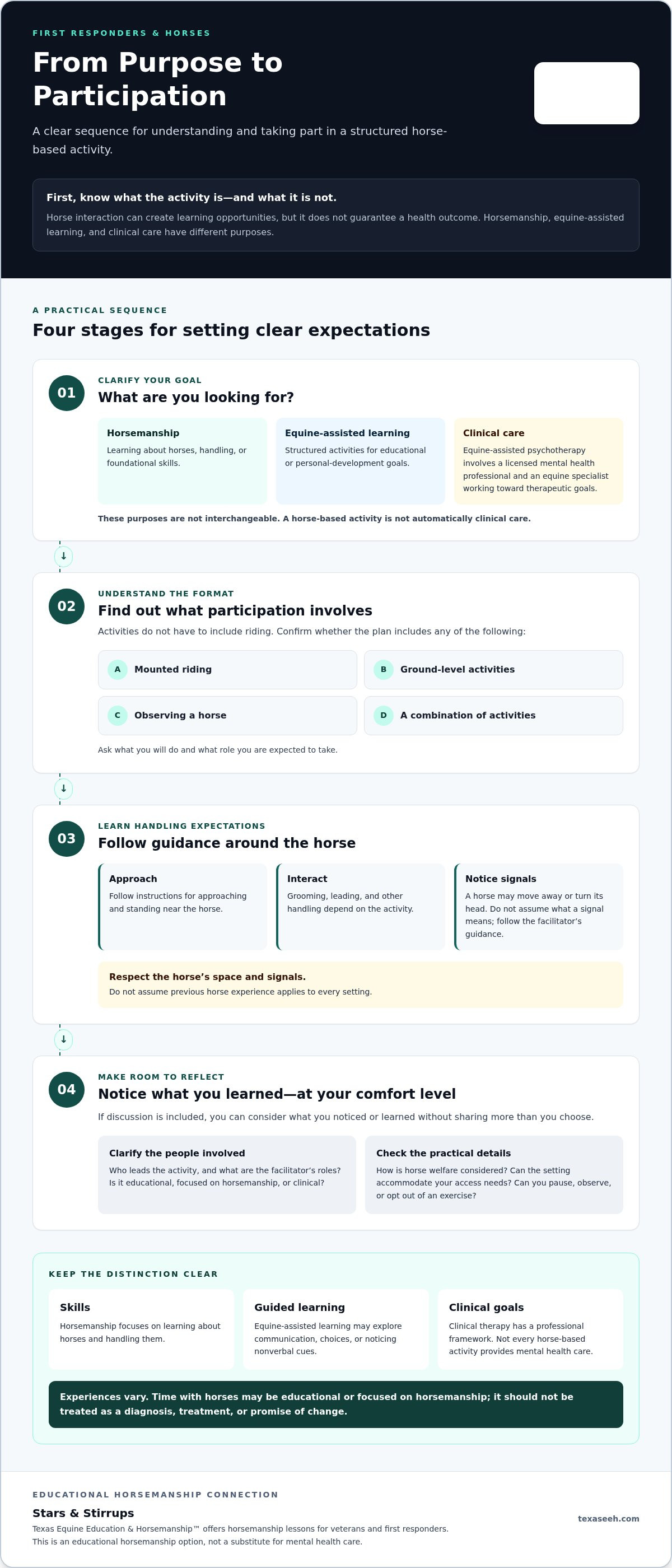
A useful sequence is straightforward:
Clarify your goal. Decide whether you are interested in horsemanship, an educational experience, or clinical support. These goals call for different kinds of activities.
Understand the format. Identify whether the plan includes mounted riding, ground-level activities, observation, or a combination.
Learn handling expectations. Follow instructions for approaching, standing near, and interacting with the horse. Don’t assume that previous horse experience applies to every setting.
Make room to reflect. If discussion is included, consider what you noticed or learned. You can reflect without sharing more than you choose.
Follow the facilitator’s instructions, and respect the horse’s space and signals. A horse may move away, turn its head, or show other changes in behavior. Don’t assume what a signal means; follow the facilitator’s guidance about how to respond.
Questions that help set realistic expectations
Before participating, establish the activity’s purpose and who leads it. Is it educational, focused on horsemanship, or clinical? What will participants do, and what are the facilitator’s roles? Consider how horse welfare is built into the activity, whether the setting can accommodate your access needs, and whether you can pause, observe, or opt out of an exercise. These details help you compare the activity with your goals and comfort level.
The Massachusetts Equine Therapy Program for First Responders is one example of a program described by a state government source. For a broader explanation of terminology, the article “A Professional Guide to Equine-Assisted Services” can offer useful context alongside this practical checklist.
Connecting First Responders with Horsemanship Through Texas Equine Education & Horsemanship™
For first responders whose goal is to learn horse-handling skills, horsemanship offers a practical way to become familiar with horses and their care. It is distinct from clinical therapy: the focus is education and interaction, not diagnosing or treating a health condition. Understanding that distinction makes it easier to choose an activity that matches your purpose.
A topic-relevant horsemanship connection
Texas Equine Education & Horsemanship™ connects first responders with horsemanship through Stars & Stirrups, a program offering horsemanship lessons for veterans and first responders. It is an educational horsemanship option, not a substitute for mental health care. For readers exploring the related but distinct audience of veterans, Horsemanship for Veterans: Professional Benefits Guide provides additional context.
When considering a horsemanship lesson, identify the skills you want to learn and the kind of interaction you are comfortable with. Someone seeking horse-handling skills may have different expectations from someone seeking clinical support. Naming that difference helps keep the activity’s purpose clear.
Keep the decision personal and practical. Choose an experience that aligns with your goals, and consider its format before participating. Time with horses can be meaningful as education or horsemanship, while clinical needs call for care designed to address them. Clear expectations help keep those paths distinct.
Take a Thoughtful Next Step
Before choosing an activity, name what you hope to get from it. You might want to build practical skills, learn about horse care, or take part in guided reflection. A specific goal helps you identify which details matter, such as whether the activity involves riding or focuses on ground-level handling.
For first responders and horses, a useful next step is one that respects your comfort and reasons for participating. Write down what you want to understand about the activity, including its purpose, format, and your role. Use those points to decide whether it fits.
If horsemanship lessons match your goal, explore Stars & Stirrups to learn about Texas Equine Education & Horsemanship™’s program for veterans and first responders. Review the program details and consider whether an educational horsemanship experience is the right next step for you.
Frequently Asked Questions
Do first responders need horse-riding experience to take part in horse-based activities?
No. Riding experience isn’t required for every horse-based activity; some are designed around ground-level participation. Check the activity description for whether it involves mounting, handling a lead rope, or observing. Knowing the format can help you consider practical needs, such as appropriate clothing, mobility considerations, and your comfort around horses.
Are equine-assisted activities the same as equine therapy?
No. The activity’s label alone doesn’t mean it provides clinical care. A session focused on learning horse-care routines differs from psychotherapy, which addresses therapeutic goals with a licensed mental health professional. The stated goals and facilitator roles help clarify the kind of activity and what it is designed to provide.
How can horses support learning for first responders?
Horses can give learners a concrete focus for practicing observation and communication. For example, a group might notice how a horse responds to calm, consistent cues and discuss what clear communication looks like. This can prompt reflection about teamwork, but it isn’t proof of a clinical benefit or a substitute for mental health care.
What is Stars & Stirrups?
Stars & Stirrups offers horsemanship lessons for veterans and first responders. The program information describes a free lesson program and a 50% discount on horsemanship lessons for veterans and first responders. These lesson details describe an educational offering, not clinical care or a particular health outcome.


Comments