


What is Equine-Assisted Learning? Benefits and Overview

What if learning with horses didn’t require getting in the saddle? Equine-assisted learning (EAL) uses guided, horse-centered activities to explore skills such as communication, problem-solving, and self-awareness. The horse is part of the learning environment, while a facilitator connects each activity to a clear educational goal.
EAL is easy to confuse with equine therapy or therapeutic riding, since all involve people and horses. But EAL is education, not clinical treatment, and riding isn’t required. Activities may take place on the ground, with mounted work included in some settings. In this guide, you’ll learn what participants may do, how EAL differs from therapy and riding lessons, and how to recognize a thoughtfully structured experience.
Table of Contents
What Is Equine-Assisted Learning? A Clear Definition and Its Boundaries
Equine-assisted learning is a facilitated, horse-centered experience in which activities are planned around educational or developmental goals. The horse is part of the learning environment, and a facilitator helps participants connect what happens during an activity to its purpose. The format can be adapted to different learners and objectives.
Some activities take place entirely on the ground, such as observing a horse’s responses or completing a supervised task nearby. Riding may be included in some settings, but it isn’t a defining feature. The focus is the learning goal, not whether a participant gets in the saddle. For context on how learning fits among other services involving horses, see this overview of equine-assisted therapy.
How Equine-Assisted Learning Differs from Therapy and Riding Lessons
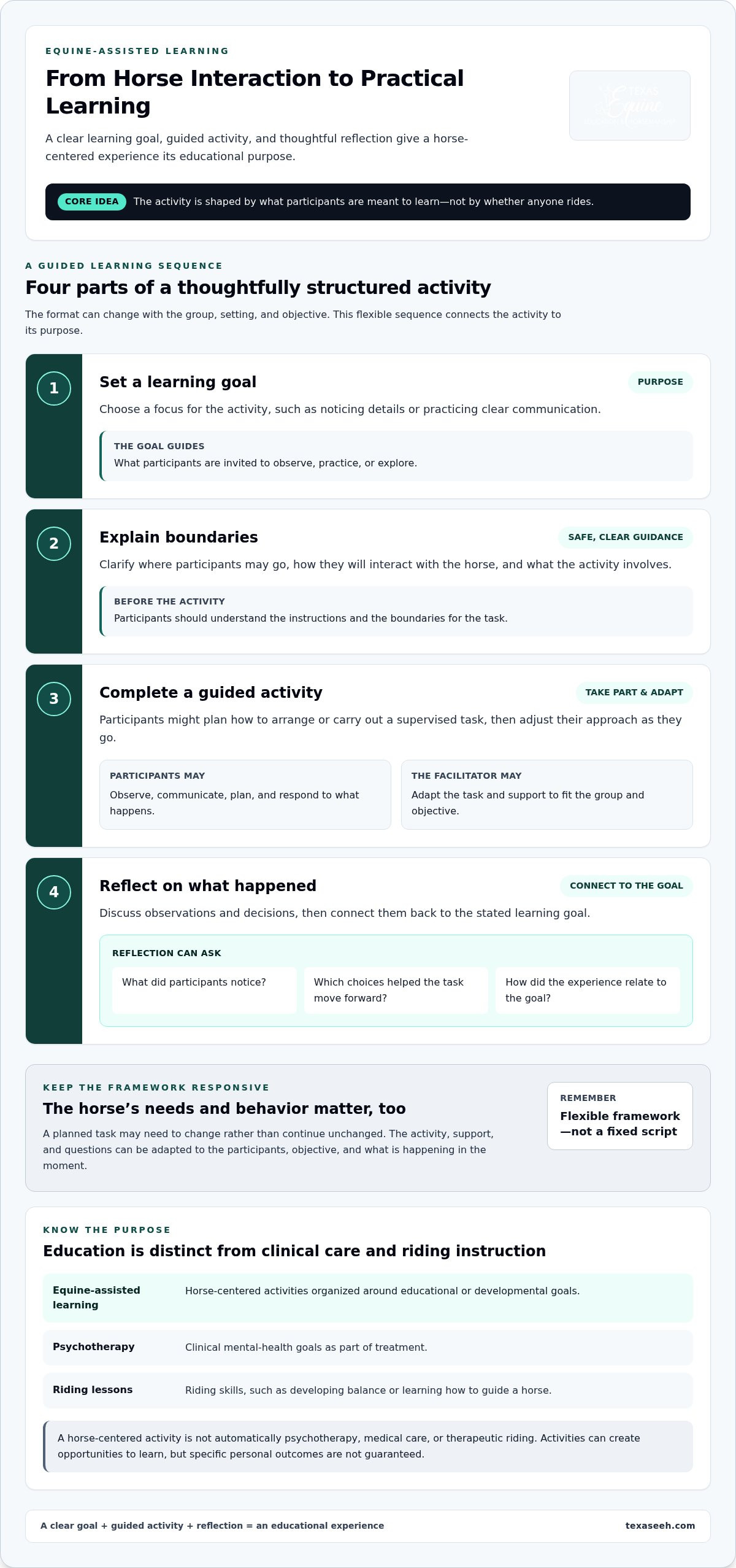
The distinction begins with purpose. Learning activities are organized around educational aims, while psychotherapy addresses clinical mental-health goals as part of treatment. An activity involving a horse isn’t automatically psychotherapy, medical care, or therapeutic riding. These terms describe different services and shouldn’t be used interchangeably.
Riding lessons focus on riding skills, such as developing balance or learning how to guide a horse. A learning activity may instead ask participants to observe a horse’s behavior, communicate clearly, or plan a task together, with a facilitator guiding the process. The activity can involve horses without being a riding lesson.
In short, equine-assisted learning is education guided by horse-centered activities; therapy is clinical care with a treatment purpose. Keeping that boundary clear helps participants understand what an experience is designed to offer, without assuming that it provides clinical care or guarantees a particular personal outcome.
How Equine-Assisted Learning Turns Horse Interaction into Practical Learning
A horse-centered activity becomes educational when it has a clear purpose and is followed by time to make sense of the experience. The format can vary with the participants, setting, and learning objectives, but a facilitator may use a sequence like this:
Set a learning goal. Choose a focus, such as noticing details or practicing clear communication.
Explain boundaries. Clarify where participants may go, how they’ll interact with the horse, and what the activity involves.
Complete a guided activity. Participants might plan how to arrange or carry out a supervised task, adjusting their approach as they go.
Reflect on what happened. Discuss observations and decisions, then connect them back to the stated goal.
This is a flexible framework, not a universal script. A facilitator adapts the activity, level of support, and questions to the group and objective. The horse’s behavior and needs also shape what can happen in the moment, so a planned task may need to change rather than continue unchanged.
What Participants May Learn Through a Guided Activity
Activities can create opportunities to explore observation, communication, patience, or problem-solving. For example, participants might identify what they need to know before beginning a task, agree on a plan, and adjust it if the task doesn’t go as expected. These are possible learning topics, not guaranteed results.
Reflection makes the connection explicit: What did participants notice? Which choices helped the task move forward? How did their approach relate to the original goal? The facilitator’s learning goal gives a horse-centered activity its educational purpose. Without that goal and a thoughtful review, an activity may be engaging, but its intended lesson can remain unclear.
What to Expect from Equine-Assisted Learning: A Grounded Next Step
A thoughtfully planned equine-assisted learning experience makes its purpose clear before an activity begins. Participants should understand what they’ll be doing, how they’ll be guided, and how the activity connects to a learning objective. Appropriate supervision helps keep the experience structured and responsive to both participants and the horse.
To assess whether an activity is well structured, look for a stated goal, instructions that fit the task, clear interaction boundaries, and time to reflect afterward. The format and activities can vary with the setting and objectives, and participants may take away different things. An intentional experience creates room to consider what was learned, but it shouldn’t promise a particular personal or clinical outcome.
Reflection can also clarify the scope of an experience. Is its purpose educational? What will participants be invited to notice or practice? How will the activity be guided? These questions help distinguish a learning experience from riding instruction or clinical care, without assuming every program follows the same format.
How Foundational Horsemanship Education Connects to Learning with Horses
Foundational horsemanship education is a separate way to build practical knowledge about horses. It can cover the basics of understanding horses and their care, while EAL uses horse-centered activities to explore a defined learning goal. Both are educational, but they have different purposes. Neither should be assumed to provide clinical treatment.
Build Your Horse Knowledge One Step at a Time
Let questions guide what you learn next. You might want to understand how horses communicate, what daily care involves, or how people build safe, respectful interactions with them. Choose one subject at a time and give yourself room to develop familiarity gradually instead of expecting to understand everything at once.
A useful approach is to start with clear, beginner-friendly information and connect new ideas to what you observe in supervised settings. Keep track of unfamiliar terms and questions, then use them to guide further learning. If you want to continue with practical horse knowledge, explore Texas Equine Education & Horsemanship’s foundational horsemanship and equine care education for learners of all ages.
Frequently Asked Questions
What is equine-assisted learning?
Equine-assisted learning is an educational approach that uses planned interaction with horses to explore a defined learning objective. For example, a group might work through a shared task and then discuss how they organized their ideas. The activity’s value comes from connecting the experience to a learning purpose, not from assuming that simply spending time with a horse teaches a particular lesson.
Is equine-assisted learning the same as equine therapy?
No. Equine-assisted learning is education, while equine-assisted psychotherapy is a form of mental health treatment involving a licensed mental health professional. A session’s setting or use of horses alone doesn’t determine its purpose. If someone needs clinical care, an educational activity shouldn’t be treated as a substitute for it.
Do you have to ride a horse for equine-assisted learning?
No. Riding ability isn’t a prerequisite for participating in a ground-based learning activity. Depending on the session’s purpose, participants might complete a supervised exercise without mounting. Some settings may include riding, but it isn’t what makes an activity educational. The learning objective and how the activity is facilitated matter more than being in the saddle.
What skills can equine-assisted learning help participants practice?
Activities may offer a chance to practice listening, cooperating, making decisions, or adjusting a plan. For example, a small group could agree on a sequence for a supervised task, notice when their approach needs to change, and discuss how they reached that decision. These are possible areas of practice, not guaranteed outcomes or clinical benefits.


Comments