


Guide to Succeeding in Virtual Equestrian Competitions

What makes a strong virtual equestrian competition entry? It is not necessarily the most polished video, but one that lets the judge assess your horsemanship clearly. Preparing an entry can raise practical questions: what can a judge see on screen, how should you set up the recording, and will competing online feel meaningful? Video offers a useful view of a ride, but it cannot capture every detail of the horse and rider’s experience.
A thoughtful entry starts with understanding what the camera can show and planning a calm setup for both horse and rider. This guide explains how to prepare, record, and review your submission while following the show’s specific instructions. You’ll also find ways to make the experience a constructive part of your learning, whether it’s your first online entry or another step in your riding journey.
Table of Contents
What makes a virtual equestrian competition different from an in-person show?
A virtual equestrian competition is assessed from submitted media rather than watched live in the ring. The format can vary, so read the class description and recording instructions to find out what to submit and what the judge will assess. Avoid assuming every online show follows the same process.
At an in-person show, a judge can observe the horse and rider from changing angles and across the whole ring. In a recording, the view is limited to the camera’s position and the moments it captures. Video can show elements of a performance, but it cannot recreate the full ringside perspective or establish details about the horse, equipment, or conditions beyond the frame.
What can a competition video communicate about horse and rider?
Framing affects what a judge can assess. If the camera is too close, too far away, or obstructed, details of the movement and partnership may be difficult to see. An unobstructed view that keeps horse and rider visible through the required work gives the judge clearer evidence to consider. The aim is not to make the ride look dramatic, but to show it clearly.
A virtual entry is a performance assessed from submitted media; an in-person round is observed live in the show ring. That distinction matters: a recording can show visible movement and responses during the captured ride, but it cannot answer questions the footage does not reveal. The stated class criteria define the scope of the assessment. Equestrian sport includes varied disciplines, as this overview of equestrian sports disciplines illustrates. Before riding, check the class description and recording instructions so you know what the judge is being asked to evaluate.
How to prepare a clear, welfare-aware virtual equestrian competition entry
Start with a plan for the class, then set up the camera. The instructions explain what the judge expects to see and how to submit the entry. Requirements can differ between shows, so follow the organizer’s directions. General US Equestrian Federation competition guidelines offer broader competition context, but do not replace the instructions for your class.
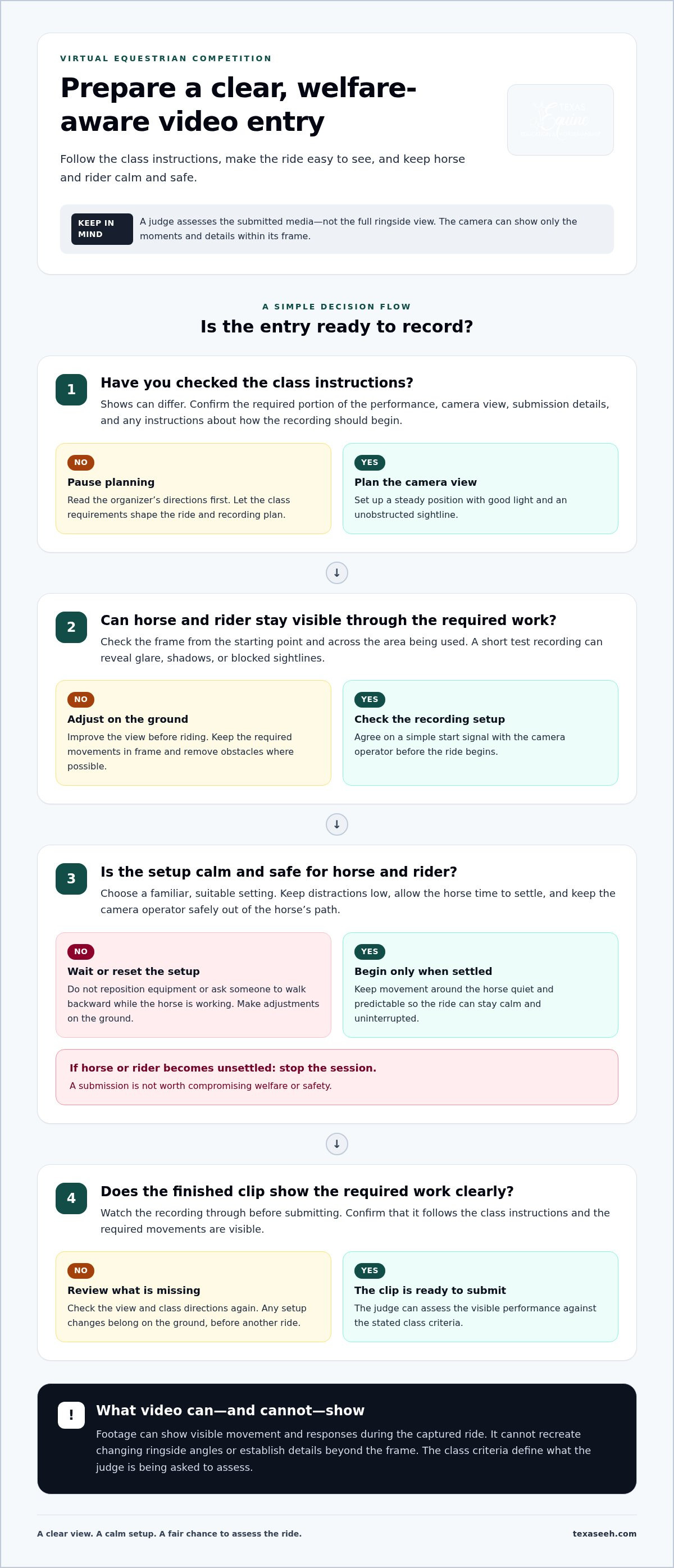
Review the instructions. Note the required portion of the performance, camera view, and submission details. Check whether the instructions specify how the recording should begin or what the entry must show.
Plan the recording. Choose a steady camera position with good light and a clear sightline. Check that horse and rider remain visible throughout the required work, without obstacles blocking the view.
Prepare calmly. Use a familiar, suitable setting where the camera operator can stay safely out of the horse’s path and the recording will not interfere with riding. Keep distractions to a minimum and allow time for the horse to settle.
Review the clip. Watch it through before submitting. Confirm the required movements are visible and the footage follows the class instructions.
How should riders record a virtual competition performance?
Set up the camera before riding, and keep the operator in a safe position away from the horse’s movement. Do not ask someone to walk backward or reposition equipment while the horse is working. If either horse or rider becomes unsettled, stop the session. A submission is not worth compromising welfare or safety.
Before the ride, check the frame from the horse’s starting point and, if possible, across the full area used. A short test recording can reveal glare, shadows, or blocked sightlines. Agree on a simple start signal with the camera operator so both of you know when recording begins. Keep movement around the horse quiet and predictable, and make any adjustments on the ground so the performance can remain calm and uninterrupted.
After your virtual equestrian competition: reflect, learn, and choose a next step
Results can offer useful direction, but placement is only one part of the experience. Read feedback in light of the show’s stated class criteria. A judge’s comments address the performance against those criteria, not every aspect of your partnership or progress. Virtual formats also differ by discipline, as the Equestrian Vaulting USA virtual competition details demonstrate.
How can riders make useful progress after receiving results?
Watch your recording again and compare what you notice with the judge’s comments. Identify one strength to recognize, such as a steady rhythm or a clear transition, and one skill to develop. If the feedback differs from your impression, revisit the relevant moment in the footage and consider it against the class criteria. A single comment is not a complete picture of your riding.
Choose one realistic practice focus before entering another class. For example, if the feedback points to an inconsistent transition, work on preparing that transition in your usual schooling before making it the focus of another entry. A specific, manageable goal gives you something useful to observe next time, regardless of your placing.
A virtual equestrian competition can support a rider’s learning when reflection leads to a clear next goal. Texas Equine Education & Horsemanship™ hosts the Horse & Rider Showcase, with online horse shows in English and Western disciplines. Explore the Horse & Rider Showcase horse shows as one way to put that goal into practice at a thoughtful pace.
Let Your Next Ride Build on This One
Your next step does not need to be a bigger result or a perfect performance. Choose an intention that feels useful for you and your horse, whether that means continuing to develop a skill or setting a new goal. A virtual equestrian competition can give that goal shape and create another opportunity to learn.
Before you enter, use the class criteria to choose a suitable goal and check that your planned recording can show the required work clearly. When you’re ready to take part, explore the Horse & Rider Showcase. A thoughtful ride can help you grow, one step at a time.
Frequently Asked Questions
Can beginners enter a virtual equestrian competition?
Yes, beginners can enter if the show offers a suitable class and they meet its stated requirements. Choose a class that matches your current experience rather than selecting one solely for its title. A first entry can help you become familiar with submitting a performance and receiving feedback. Keep the horse’s comfort and your own confidence central to the decision.
Can I use an older video for a virtual horse show entry?
Only if the show’s instructions allow previously recorded footage. The organizer may specify when a performance must have been filmed or require details that identify the entry. An older clip might not meet those conditions, even if it shows the same horse and rider. Read the current submission directions and use footage that accurately represents the performance being entered.
Does a virtual equestrian competition replace an in-person horse show?
No. It offers a different way to participate, not a complete substitute for every part of showing in person. A recording provides a chance to present a performance for assessment, while an in-person show includes the experience of riding at a live event. Riders can choose either format, or both, according to their goals, circumstances, and horse’s readiness.
Are results from different virtual horse shows directly comparable?
Not necessarily. Shows may use different class descriptions, judging criteria, submission requirements, or scoring approaches, so a placing in one event may not translate directly to another. For a useful comparison, review the criteria for each class and consider the comments alongside your riding goals. Track your development over time rather than treating results as a shared scale.


Comments