


Horse Show Judging: What Every Rider Needs to Know

A hunter score is more than a tally of rails: horse show judging considers the quality of the whole round, including the horse’s way of going and the rider’s execution. A knockdown or refusal can sharply affect the result, while smaller mistakes may lower a score without ending the round.
A score sheet can be hard to interpret because each mark reflects a different part of the performance. This guide explains how judges assess hunter rounds, what they look for in Saddlebred movement and balance, and how equitation criteria shape a result. It also explains how judging resources and score sheets can help connect a posted score with what happened in the ring.
Table of Contents
Hunter and equitation judging criteria
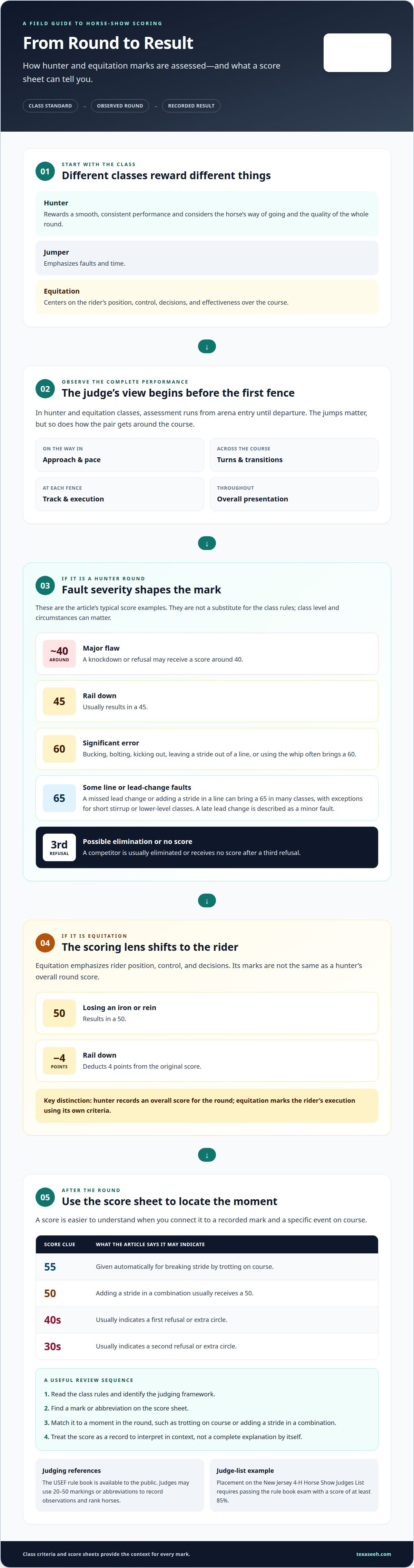
Common English riding classes include hunter, jumper, and equitation, each judged on different aspects of the performance. Hunter judging considers the horse’s way of going and the quality of the round; jumper results emphasize faults and time, while equitation evaluates the rider’s position and effectiveness.
In hunter and equitation classes, judges assess the competitor from arena entry until departure. That means the approach, pace, turns, transitions, and overall presentation can contribute to the impression, not just the jumps. A late lead change is a minor hunter fault, while a missed change or adding a stride in a line can bring a score of 65 in many classes, with exceptions for short stirrup or lower-level classes.
Faults affect hunter scores according to their severity. A rail down usually results in a 45, while bucking, bolting, kicking out, leaving a stride out of a line, or using the whip often brings a 60. A major flaw such as a knockdown or refusal may receive a score around 40. A horse and rider are usually eliminated or receive no score after a third refusal.
Equitation places more emphasis on the rider’s control, position, and decisions over the course. For example, losing an iron or rein results in a 50, while a rail down deducts 4 points from the original score. Those marks differ from hunter scoring, where the judge records an overall score for the round. This distinction helps explain why the same obstacle fault can affect class results differently.
For riders, the key comparison is each class’s objective: hunter rewards a smooth, consistent performance, jumper judging tracks faults and time, and equitation centers on how the rider navigates the course. Understanding these differences makes horse show judging easier to interpret when reviewing a posted score.
Horse show judging resources and score sheets
A score sheet turns a hunter round into a record you can review after leaving the ring. The USEF rule book is available to the general public and explains faults that may affect a score. Judges may also use systems of 20-50 markings or abbreviations to record observations and rank horses. Those notes can help distinguish a smooth trip from one affected by a course error.
Hunter scores use a broad scale, so a single number needs context. Hunter scores are often interpreted in broad performance bands, so the score should be read in context. A 55 is given automatically for breaking stride by trotting on course, while adding a stride in a combination usually receives a 50. A score in the 40s usually indicates a first refusal or extra circle; the 30s usually indicates a second refusal or extra circle.
Exhibitors can prepare by reading the class rules, then reviewing the score sheet after a round. Compare each recorded mark with a specific moment, such as trotting on course or adding a stride in a combination. This turns a number into a practical training note. For example, a 55 points to a broken stride caused by trotting, while a 50 usually points to an added stride in a combination. A clinic can also help riders become familiar with judging language and score-sheet patterns.
For prospective judges, placement on the New Jersey 4-H Horse Show Judges List requires passing the rule book exam with a score of at least 85%.
Texas Equine Education & Horsemanship™: Horse & Rider Showcase
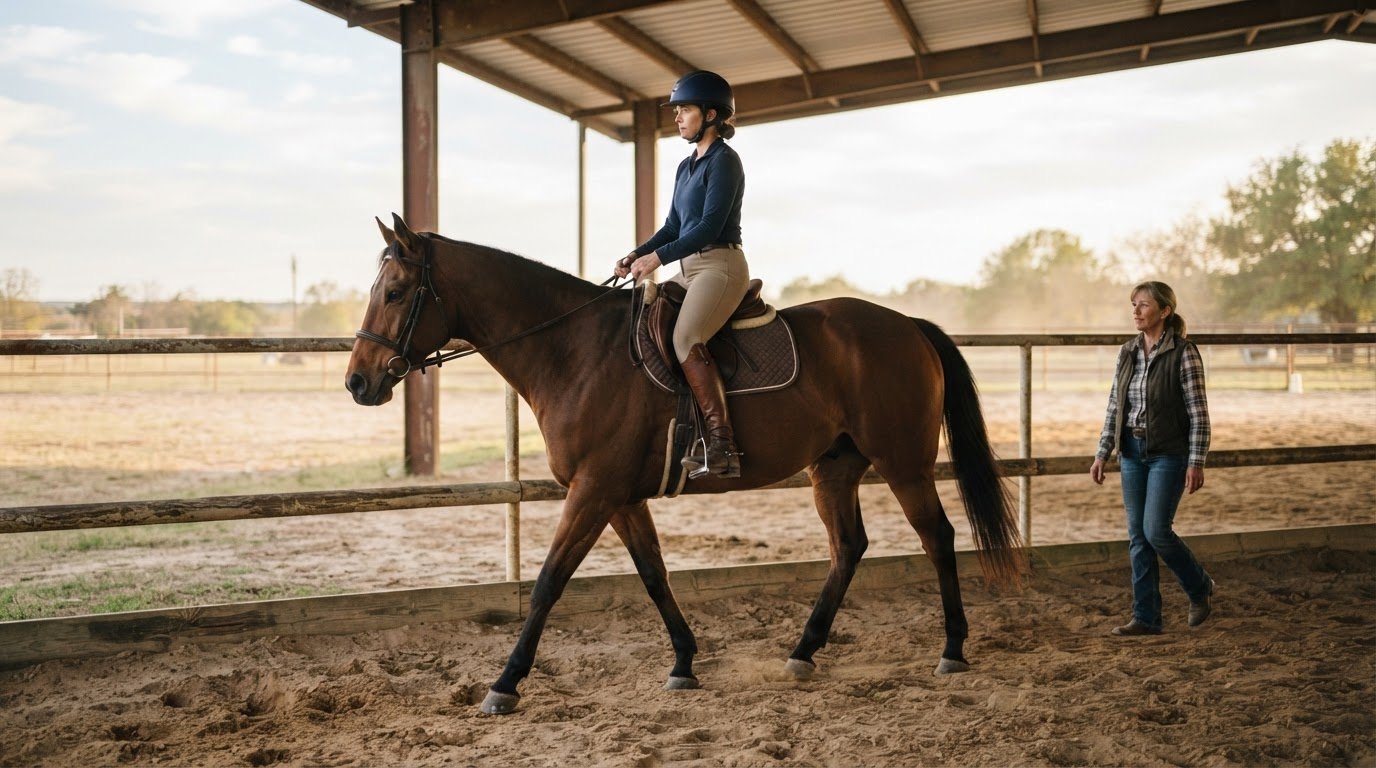
When learning how judges assess a horse-and-rider pair, observe how the horse moves, how the rider communicates, and how the pair travels through a class. These observations connect written criteria with what the combination presents.
Use this article to observe thoughtfully, not as a substitute for official class rules or a judge’s score sheet. Note whether the horse maintains a steady rhythm, the rider guides smoothly, and the pair appears balanced through turns and transitions. These are useful viewing points, but don’t assume a showcase follows a particular discipline’s scoring system. Hunter, jumper, and equitation classes have different judging priorities.
The Horse & Rider Showcase is a relevant example for readers interested in horse-and-rider presentation, while rule books and class-specific score sheets remain the references for interpreting formal results. Keeping these purposes distinct helps prevent a general impression from being mistaken for an official score or placing.
As you continue learning, choose a specific example from a class and identify what you observed: movement, rider position, or a transition. Then connect that observation to the right judging framework. This reflection builds familiarity with horse-show terminology without treating every performance as if it were judged by the same standard.
Texas Equine Education & Horsemanship™ presents the Horse & Rider Showcase as a horse-show presentation resource. Learn about the showcase.
Frequently Asked Questions
How Do Hunter Judges Score A Round?
Hunter judges assess the horse’s way of going and the quality of its round, considering the track, pace, consistency, and how smoothly it negotiates each fence. The numerical mark reflects the round as a whole, so interpret it alongside the course and class standard rather than as a complete explanation of every judging decision.
What if it ends in a tie?
A tie is resolved according to the class’s published specifications, which explain whether competitors share a placing or a tie-break method applies. Don’t assume every tie leads to a jump-off; formats differ between classes. The show’s stated conditions are the practical reference for understanding how equal scores or results affect final placings.
What is horse show judging?
Horse show judging evaluates a horse, rider, or pair against the goals and standards of a particular class. Judges observe the performance and determine scores or placings using that class’s criteria. Because disciplines reward different qualities, a strong result in one class doesn’t automatically predict how the same combination would place in another.
What criteria do judges use to evaluate horses and riders?
Criteria depend on the class. A judge may consider the horse’s movement, manners, and consistency alongside the rider’s position, control, and effectiveness. In a class focused on presentation, the overall impression matters; in equitation, the rider’s execution receives greater focus. The class description helps clarify which qualities carry the most weight.
What are the rules and scoring systems for common horse show disciplines?
Rules and scoring vary by discipline and class. Hunter classes use numerical scores, while jumper formats emphasize faults and time; equitation focuses on the rider. Saddlebred classes may feature three gaits, the walk, trot, and canter, or five, adding the slow gait and rack. The applicable class rules explain the specific format.


Comments