


Guide to Horse Saddle Parts: Master Your Equipment

The parts of a saddle do more than hold it together: they shape the rider’s seat and determine how the saddle rests on the horse. A Western saddle’s main parts include the tree, seat, horn, pommel or fork, cantle, skirt, fenders, stirrups, and rigging. Each has a distinct role, and the surfaces that contact the horse matter as much as the visible parts.
It’s easy to confuse fenders with stirrups or focus on a saddle’s shape while overlooking how it rests against the horse. This guide explains the main Western saddle parts, distinguishes fenders from stirrups, and shows how contact surfaces relate to fit. It also covers why the tree, skirt, and clearance around the horse’s back matter when assessing how a saddle sits.
Table of Contents
What is the difference between fenders and stirrups?
On a Western saddle, fenders are the broad leather pieces that hang on either side. They connect the saddle to the stirrups, which are separate foot supports. The seat is the deepest area, where the rider sits. The cantle forms the seat’s raised back edge and helps support the rider.
Fenders sit between the rider’s legs and the horse. Their position can be adjusted to change stirrup length. Stirrups hold the rider’s feet and contribute to balance while riding. For example, the stirrup is the metal or covered loop at the bottom, not the leather above it.
The cantle’s height and angle affect rider support and movement. A higher cantle offers more back support and encourages an upright posture. Cutting and reining saddles use low cantles to allow greater movement. Some ranch, trail, and work saddles have straighter cantle angles for a more secure seat. Reining and roping saddles may have tipped cantles that leave the upper body freer to move.
English saddles have a different arrangement. Their main parts include the pommel, seat, cantle, flaps, panels, billets, girth, stirrup leathers, and stirrups. The pommel sits at the front, while the cantle is behind the seat. The stirrup leather attaches at the stirrup bar and supports the stirrup.
Each part has a distinct purpose. The seat carries the rider, and the cantle supports the back of the seat. Fenders connect Western saddles to stirrups, while stirrups support the feet. On English saddles, flaps protect the rider’s legs from billet straps, and panels rest against the horse’s back. Together, these parts shape support, stability, and contact.
What are the main parts of a Western saddle?
English saddles use panels, flaps, billets, and a girth; Western saddles use a tree, skirt, rigging, and cinches. Though their structures differ, both types support the rider and secure the saddle to the horse.
Saddle Tree Components
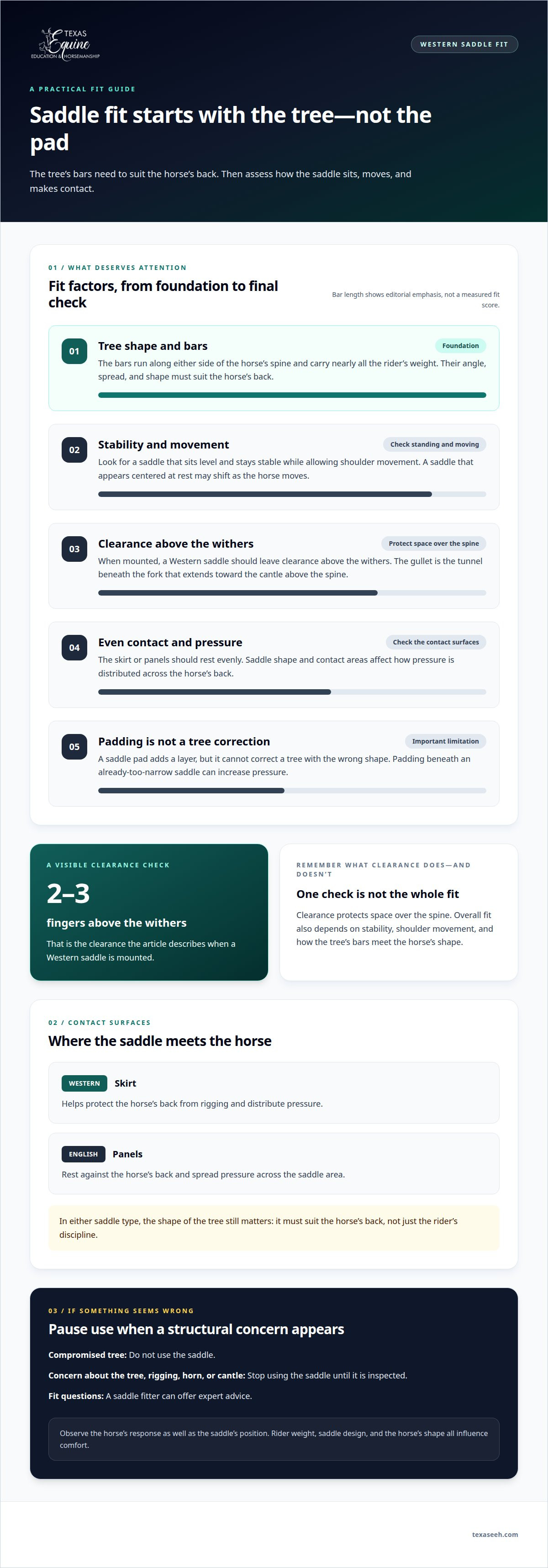
The tree is the saddle’s framework, shaping its structure and supporting the rider. Its bars run along either side of the horse’s spine and carry nearly all the rider’s weight. At the front, the fork, or pommel, includes raised swells and may hold a horn. The horn can anchor a rope when catching livestock. These parts affect balance and how the saddle sits.
Gullet Structure and Fit
The gullet is the tunnel beneath the fork, extending toward the cantle above the horse’s spine. When a Western saddle is mounted, there should be two to three fingers of clearance above the withers. The gullet width and the tree’s bar angle and spread need to suit the horse’s back. The gullet hole is part of the tree; it allows ventilation and reduces weight. Clearance protects space over the spine, while overall fit also depends on stability and shoulder movement.
Flaps, Panels, and Billets
English saddle flaps separate the rider’s legs from the billet straps, while panels rest against the horse’s back and distribute pressure across the saddle area. Billets sit beneath the flaps and attach to the girth, called a cinch on a Western saddle. These contact and fastening parts help keep the saddle in place and prevent straps from pressing directly against the rider’s legs.
Western Saddle Rigging
Western rigging joins the saddle to its cinches through metal D-rings, plates, or in-skirt attachments. The front cinch secures the saddle; the latigo connects it and is usually on the left, with an off billet usually on the right. Rigging positions include 7/8 and 3/4, progressively farther back from the fork. A back cinch helps limit bouncing and should connect to the front cinch with a hobble strap. A breastplate helps prevent backward sliding, especially uphill.
Horse-contact surfaces and saddle fit
A saddle’s contact surfaces influence how its weight rests across a horse’s back. On a Western saddle, the skirt helps protect the back from rigging and distribute pressure. On an English saddle, the panels rest against the back and spread pressure across the saddle area. The shape of the tree still matters: the bars must suit the horse’s back, not just the rider’s discipline.
Assess the saddle while the horse stands and moves. Check whether it sits level, stays stable, allows shoulder movement, and leaves clearance over the spine. A width label alone can’t show how the bars meet the horse’s shape. For example, a saddle that looks centered while the horse stands may shift during movement, changing its position and pressure points.
A saddle pad adds a layer, but it can’t correct a tree with the wrong shape. Padding beneath an already-too-narrow saddle can increase pressure. This matters across disciplines: a Western roping saddle and an English saddle have different structures, yet each needs suitable contact and freedom of movement. Rider weight, saddle design, and the horse’s shape all influence comfort.
Observe the horse’s response as well as the saddle’s position. A skirt or panel that doesn’t rest evenly can create uneven contact, while a compromised tree can affect the entire structure. Don’t use a saddle with a compromised tree. If a concern involves the tree, rigging, horn, or cantle, stop using the saddle until it’s inspected. A saddle fitter can offer expert advice on fit.
Texas Equine Education & Horsemanship™: Horse & Rider Showcase
Texas Equine Education & Horsemanship™ offers the Horse & Rider Showcase for readers interested in the connection between horses and riders. Recognizing saddle parts is one aspect of horsemanship; learning about riding and equine care builds broader understanding. An Introductory Lesson offers a starting point for learning to ride, while Equine Care Classes focus on horse care.
Consider the Horse & Rider Showcase when you’d like to continue exploring horsemanship in an event setting. Visit texaseeh.com to learn more about the showcase and related opportunities.
Build Confidence Through Continued Horsemanship
Grow your equipment knowledge alongside your horsemanship. As you handle tack, practice naming the parts of a saddle and describing each one’s purpose. Clear, specific observations can help you communicate questions about equipment and build confidence as you learn.
Keep a small riding journal to record unfamiliar terms, questions, or details you’d like to understand better. Over time, your notes can guide your next steps and help you track how your understanding develops. Stay curious, learn at a steady pace, and let each new insight deepen your connection with horses.
Frequently Asked Questions
What is a saddle tree made of?
A saddle tree may be made from wood or synthetic materials. Traditional Western trees use wood wrapped in rawhide, while modern versions may use fiberglass or molded synthetics. The material forms the frame beneath the visible leather and influences the saddle’s shape. To identify the tree, look beneath the outer covering rather than judging its construction by the surface alone.
Which Saddle Parts Can Be Repaired or Replaced?
Leather components and attached hardware may be repairable or replaceable, depending on their condition and how they connect to the saddle. A loose strap is different from tree damage, since the tree supports the saddle’s structure. If a concern may involve the tree, rigging, horn, or cantle, stop using the saddle until it has been inspected. Don’t treat a structural concern as a routine repair.
What are the parts of a saddle tree and saddle seat?
The tree includes the bars and front fork, while the gullet provides clearance above the horse’s spine. The seat is where the rider sits, and its rise is the raised portion directly behind the pommel. Think of the tree as the supporting frame beneath the seat: the rider sees the seat, but the tree gives the saddle its underlying structure.
What are the parts of a saddle that attach to the horse?
Attachment parts vary by saddle style. On a Western saddle, rigging connects the saddle to the cinch through a latigo or billet; an optional breastplate helps limit backward sliding. An English saddle uses billets to connect to the girth. These fastening pieces differ from the panels or skirt, which lie between saddle and horse rather than fastening around the body.
What saddle parts need regular inspection or replacement?
Pay attention to the parts that secure the saddle or support its structure: latigos, billets, cinches, rigging attachments, stitching, and the tree. Look for looseness, visible wear, or damage that could affect a connection. Check that the hardware remains attached and the saddle keeps its shape. If the tree, rigging, horn, or cantle is a concern, stop using the saddle until it has been inspected.


Comments