


Exploring Equestrian Art: A Guide to Equine Expression

What makes equestrian art meaningful beyond the image of a horse? A lifelike portrait may capture familiar features, yet a bent neck, lifted hoof, or rough patch of paint can suggest energy, restraint, memory, or a relationship between horse and human. It’s natural to focus first on the animal, but the choices surrounding it help tell the deeper story.
This guide will help you read those choices with greater confidence. You’ll learn how pose and movement shape a work’s mood, how materials such as paint, photography, or sculpture affect the way a horse is experienced, and how setting and symbols add context. A practical way to begin is to separate what you can see from what you think it might mean. That makes it easier to connect details to possible themes such as heritage, identity, and personal perspective without treating one interpretation as certain.
Table of Contents
What Makes Equestrian Art More Than a Portrait of a Horse?
Equestrian art includes visual work featuring horses, the people and animals connected to them, or the settings and activities that make up equine life. It can take the form of a painting, photograph, drawing, or sculpture. A horse may suggest movement, companionship, work, memory, or heritage, but none of these meanings is automatic. The artist’s choices and the viewer’s context shape how the image is understood.
A horse is the subject; the story is what the artwork makes visible about its presence, relationships, and place in human life. This distinction helps explain why two works showing similar horses can feel very different. One may focus on the animal’s physical form, while another uses the horse to explore labor, affection, identity, or remembrance. Equestrian art can also carry historical meaning. For example, History of Equestrian Statues offers context on how mounted figures have been used to express ideas about power and public memory.
How the horse’s role shapes an artwork’s meaning
Begin with what is visible before assigning symbolism. Is the horse shown alone, beside a person, or within a landscape? Notice its posture, the direction of its gaze or movement, and its distance from other figures. A horse standing apart may create a sense of solitude, while a close human-animal pairing can draw attention to connection. Check what else is in the scene: a working setting, riding equipment, or a familiar landscape can add context, but the image itself doesn’t dictate one interpretation.
These visual clues offer a grounded starting point for looking. For more historical perspective on changing depictions of horses, explore horses in art across history and modern expression.
How to Read Movement, Medium, and Detail in Equestrian Art
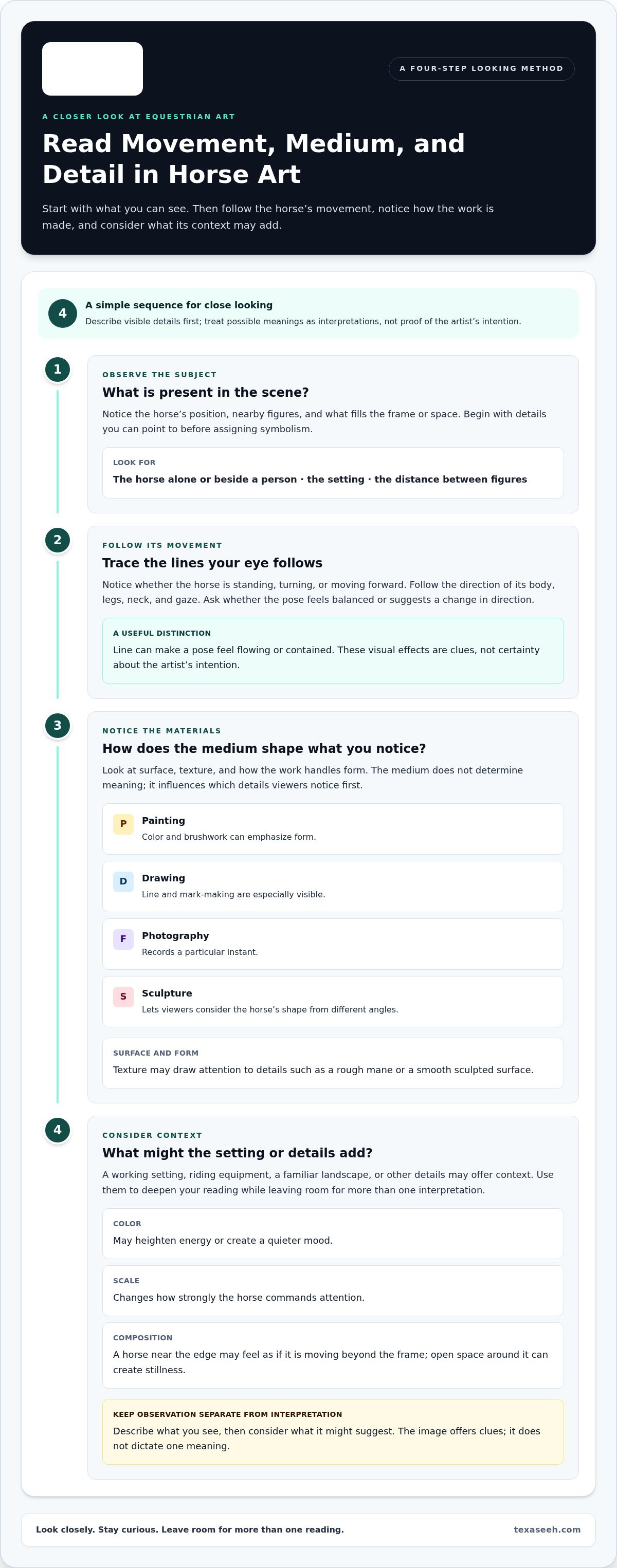
A steady sequence can make close looking feel manageable: observe the subject, follow its movement, notice the materials, and then consider the context. Begin with visible facts. Is the horse standing, turning, or moving forward? Where do its legs, neck, and gaze lead your eye? Notice whether the pose feels balanced or suggests a change in direction. This first pass gives you specific details to work with before interpretation takes over.
Observe the subject: Note the horse’s position, nearby figures, and what fills the frame or space.
Follow its movement: Trace the direction of the body and the lines that carry your eye across the image.
Notice the materials: Look at surface, texture, and how the work handles form.
Consider context: Ask what the setting or other details might add, while leaving room for more than one reading.
Line can make a pose feel flowing or contained. Color may heighten energy or create a quieter mood, while scale changes how strongly the horse commands attention. Texture draws the eye to details such as a rough mane or a smooth sculpted surface. Composition matters, too: a horse placed near the edge may feel as if it is moving beyond the frame, while open space around it can create stillness. Treat these effects as clues, not proof of the artist’s intention. The Art Institute of Chicago’s Horses in Ancient Art illustrates how the horse’s role and surrounding imagery can shape interpretation.
What to notice when looking closely at horse artwork
Painting can use color and brushwork to emphasize form; drawing makes line and mark-making especially visible. Photography records a particular instant, while sculpture lets viewers consider a horse’s shape from different angles. When comparing works, ask which details each medium makes easiest to notice, then consider how that affects your response. The medium doesn’t determine what a work means; it influences which details viewers notice first. Describe what you see, then separate that observation from your interpretation. For more approaches, see a guide to equine art styles and expression.
How Contemporary Equestrian Art Connects Personal Expression and Heritage
Contemporary artists can use horses to explore experiences that are both personal and connected to a wider past. A familiar saddle, a remembered barn, or the recurring shape of a horse in family stories may carry meaning for one artist without representing an entire community. Cultural memory can also appear through symbols, materials, or ways of depicting the horse, but their meaning depends on the artist’s own context. Avoid assuming that one image speaks for every person who shares a tradition.
As a viewer, begin with what the work shows and how it is made. Ask which details seem deliberate, what feelings or memories they bring to mind, and what you’d need to learn before interpreting a symbol. If the artist provides context, use it to deepen your understanding rather than treating it as a single answer. Curiosity leaves room for both the artist’s perspective and your own response.
A welcoming place for many ways of seeing horses
Different ages and materials can bring distinct perspectives to equestrian art. A drawing may reflect a close study of a horse’s shape, while a textile or sculpture may focus on pattern, touch, or presence. These approaches don’t need to agree to be meaningful. Shared art makes different ways of seeing horses visible, without asking them to become the same.
The Texas Equine Education & Horsemanship™ Equine Expression & Heritage Art Show celebrates equine art across all ages and mediums. Explore the show to see how personal experience, material choice, and heritage can shape an artist’s expression of a connection with horses. Its broad scope also offers a useful reminder: an artwork’s value isn’t limited to technical realism.
Keep Looking, and Let Your Curiosity Lead
The next time a horse-centered artwork catches your attention, pause with it for a little longer. Choose one detail that draws your eye, describe it plainly, and then consider what it invites you to wonder about. You don’t need to identify a single correct meaning. Your response can be a starting point for learning more about the artist’s perspective and the experiences behind the work.
That openness is part of what makes equestrian art rewarding to explore: each encounter can offer a fresh point of view. Give yourself time to notice what holds your attention, and let new questions develop naturally. With practice, looking closely becomes less about finding a single answer and more about appreciating the many ways artists and viewers connect with horses.
Frequently Asked Questions
What is equestrian art?
Equestrian art is visual work in which horses or horse-related life are a central focus. It might portray an individual animal, a riding or working scene, or places and objects closely connected to horses. The term describes the subject, not a required style: realistic, abstract, documentary, and symbolic approaches can all fit. The artist’s purpose and choices give each work its distinct character.
Why are horses commonly represented in art?
Horses have been part of human life in settings such as work, travel, sport, and companionship, giving artists many kinds of relationships to explore. Their physical presence also offers striking shapes, varied movement, and expressive interaction with people. Across different works, a horse might reflect a practical role, a personal bond, or an idea valued by the artist’s community.
Can equestrian art be made in any medium?
Yes. Artists can make horse-centered work using materials and formats suited to their ideas, from painting and printmaking to textiles, ceramics, digital illustration, or mixed media. A medium can also affect where a work is displayed and how its details are experienced. For example, a digital illustration appears on a screen, while a ceramic work has a physical surface and volume.
How can I understand the meaning of a horse artwork?
Start by describing specific evidence in the work, such as a visible object, repeated shape, or contrast between figures. Then ask what that detail suggests to you, and keep that response separate from what you can verify about the artist or setting. For example, a familiar piece of tack may prompt a personal memory, but the artist’s notes may offer a different context.


Comments