


Essential Horse Anatomy: A Guide for Equine Care

What can a horse’s shape tell you about how it moves, and what can’t it tell you about its health? Learning horse anatomy makes unfamiliar diagrams and body part names easier to understand, especially when you connect visible landmarks with their roles in movement.
You don’t need a veterinary background to build a useful foundation. This guide explains the horse’s major external regions and how bones, joints, muscles, tendons, and ligaments work together. You’ll also learn a practical way to observe posture and movement, and why those observations can’t replace a veterinary assessment.
Table of Contents
Horse Anatomy Basics: How to Read the Main Body Regions
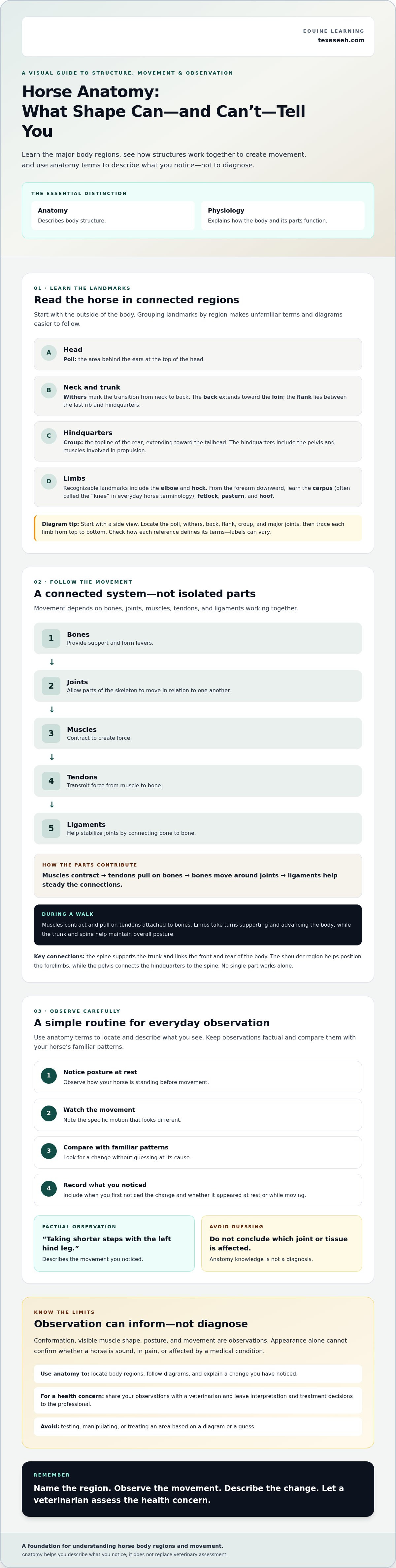
Horse anatomy is the study of a horse’s body structure, from visible landmarks to internal parts. Grouping the body into regions gives unfamiliar terms a place. A diagram may identify the neck, for example, before naming structures within it. Anatomy describes body structure; physiology explains how the body and its parts function.
Think of the regions as connected areas, not separate pieces. The head joins the neck, which meets the trunk. The limbs support the body and enable movement. The hindquarters describe the rear region, including the pelvis and muscles involved in propulsion. This Equine anatomy overview offers a broader reference for exploring external parts and body systems.
Head: includes the poll, the area behind the ears at the top of the head.
Neck and trunk: the withers mark the transition from neck to back. The back extends toward the loin, while the flank lies between the last rib and hindquarters.
Hindquarters: the croup is the topline of the rear, extending toward the tailhead.
Limbs: include recognizable joints such as the elbow and hock. Below the forearm, the carpus is often called the “knee” in everyday horse terminology. Lower down, the fetlock, pastern, and hoof are useful landmarks to learn on a labeled diagram.
What are the main external parts of a horse?
Start with a side view diagram and locate the poll, withers, back, flank, croup, and major joints. Then trace each limb from top to bottom and check where the forearm, carpus, fetlock, pastern, and hoof appear. Labels can differ between everyday conversation, riding instruction, and anatomical references, so check how a diagram defines each term. A simple reference with consistent labels makes new vocabulary easier to follow.
How the Horse Skeleton and Muscles Support Movement
A horse’s movement depends on connected structures working together. Bones provide support and form levers. Joints allow parts of the skeleton to move in relation to one another. Muscles contract to create force, tendons transmit that force from muscle to bone, and ligaments help stabilize joints by connecting bone to bone.
The spine supports the trunk and links the front and rear of the body. The shoulder region helps position the forelimbs, while the pelvis connects the hindquarters to the spine. Muscles across the trunk and limbs contribute to posture and movement. No single part works alone.
In movement, bones provide the framework, joints allow motion, and muscles use tendons to move the framework while ligaments help steady its connections.
How do a horse’s bones and muscles work together?
Consider a step at the walk. As muscles contract, they pull on tendons attached to bones, moving those bones around joints. The limbs take turns supporting and advancing the body, while the trunk and spine help maintain overall posture. This basic sequence is a useful way to follow a diagram or lesson, though real movement involves many structures acting in coordination.
Appearance alone can’t confirm whether a horse is sound, in pain, or affected by a medical condition. Conformation and visible muscle shape are observations, not diagnoses. For general context on routine examination, the MSD Veterinary Manual offers guidance on observing your horse's health. If a change in movement concerns you, share what you’ve noticed with a veterinarian rather than trying to identify its cause yourself.
Using Horse Anatomy Knowledge for Careful Everyday Observation
Knowing the names of body regions can help you describe what you see, but observation is different from diagnosis. Use a consistent routine: notice your horse’s posture at rest, watch how they move, compare what you observe with their familiar patterns, and record changes. Note the specific movement that looks different and when you first noticed it, rather than guessing at a cause.
Keep the description factual. “Taking shorter steps with the left hind leg” is more useful to share than a conclusion about which joint or tissue is affected. If you keep notes, include what you observed and the circumstances, such as whether the change appeared at rest or while moving. Horse anatomy can help you locate and explain what you noticed, but appearance or movement alone can’t establish pain, soundness, or a medical condition.
Can anatomy knowledge help you notice changes without diagnosing?
Yes. Anatomy gives you shared terms for discussing visible regions and movement with an equine veterinarian, while leaving interpretation and treatment decisions to the professional. If you have a health concern, contact your veterinarian and share your observations. Avoid testing, manipulating, or treating an area based on an anatomy diagram or a guess.
Continue building your understanding with reliable equine care resources and instruction. Foundational care education can help you learn body part terms and observe consistently, while veterinary assessment remains essential for interpreting health concerns.
Build Confidence Through Everyday Observation
Understanding horse anatomy makes body region terms easier to follow and shows how the skeleton and muscles contribute to movement. Careful observation has limits, though: noticing a change in posture or motion can help you describe it, but it can’t reveal its cause or replace a veterinary assessment.
Keep learning one step at a time. Observe familiar patterns, note changes clearly, and share health concerns with an equine veterinarian. To build foundational knowledge, explore horsemanship and equine care classes from Texas Equine Education & Horsemanship™.
Each new term can make it easier to understand what you see and communicate thoughtfully about your horse’s care. Explore the classes and education programs from Texas Equine Education & Horsemanship™ to continue building your foundation.
Frequently Asked Questions
What are the main parts of a horse’s body?
The main body regions are the head, neck, trunk, limbs, and hindquarters. Familiar external landmarks include the poll behind the ears, the withers where the neck meets the back, the flank beside the abdomen, and the croup over the hindquarters. Learning these broad regions first can make more detailed anatomical terms easier to locate and understand.
What is the difference between horse anatomy and physiology?
Horse anatomy describes body structure, while physiology explains how the body and its parts function. For example, anatomy identifies a joint and the bones around it; physiology considers how those structures work with muscles and other tissues during movement. The subjects are connected, but knowing a structure’s name doesn’t automatically explain every aspect of its function.
How does a horse’s anatomy affect the way it moves?
A horse’s anatomy supports movement through coordinated structures. Bones provide a framework, joints allow motion, muscles generate force, tendons transmit that force to bones, and ligaments help stabilize joints. The spine, shoulder region, pelvis, and limbs each contribute to support and movement. A change in one area can affect how the horse moves overall, but the cause isn’t always visible.
Can learning horse anatomy help me identify a health problem?
Learning horse anatomy can help you describe a change, but it can’t diagnose a health problem. You might notice a different posture or shorter steps and record when the change occurs. Share those observations with an equine veterinarian, who can assess the horse and determine what they mean. Don’t rely on appearance alone to identify pain, confirm soundness, or choose treatment.


Comments