


Choosing the Right Equine Industry Certification Program: A Guide to Career Readiness

Updated: Aug 8
A professional equine career is built on much more than just the ability to ride; it's rooted in the quiet moments of ground-up care and a deep understanding of horse behavior. You've probably noticed that many traditional courses focus heavily on the classroom while skipping the practical skills that managers actually look for. It's difficult to feel prepared when your schedule is packed and you're trying to find an equine industry certification program that actually fits your life.
You deserve a learning path that respects your time and your passion for horses. This guide will help you evaluate programs to find a path that balances professional skill-building with the flexibility your life requires. We'll explore how to identify modular learning options that teach the "why" behind every task, ensuring you gain the stability and versatility needed to thrive in a field that supports over 1.7 million jobs across the country.
Table of Contents
What Defines a Quality Equine Industry Certification Program?
A quality equine industry certification program is more than just a certificate to hang on a wall; it is a professional credential that validates both your theoretical knowledge and your practical, hands-on skill. In a field as physical and intuitive as Equestrianism, a piece of paper only holds value if it represents real-world competence. True industry readiness is defined as the ability to handle equine management tasks independently and safely, ensuring the well-being of both the horse and the handler in a professional environment.
The modern horse world is seeing a significant shift away from "riding-only" certifications. While being a skilled rider is wonderful, professional facilities now prioritize holistic horsemanship and comprehensive equine care. Our core philosophy, "Where Horses Inspire Learning™," reflects this change by positioning the horse as the primary teacher. This approach ensures that students don't just learn to follow instructions; they learn to listen to what the horse is telling them through its behavior and physical condition.
Core Competencies Employers Look For
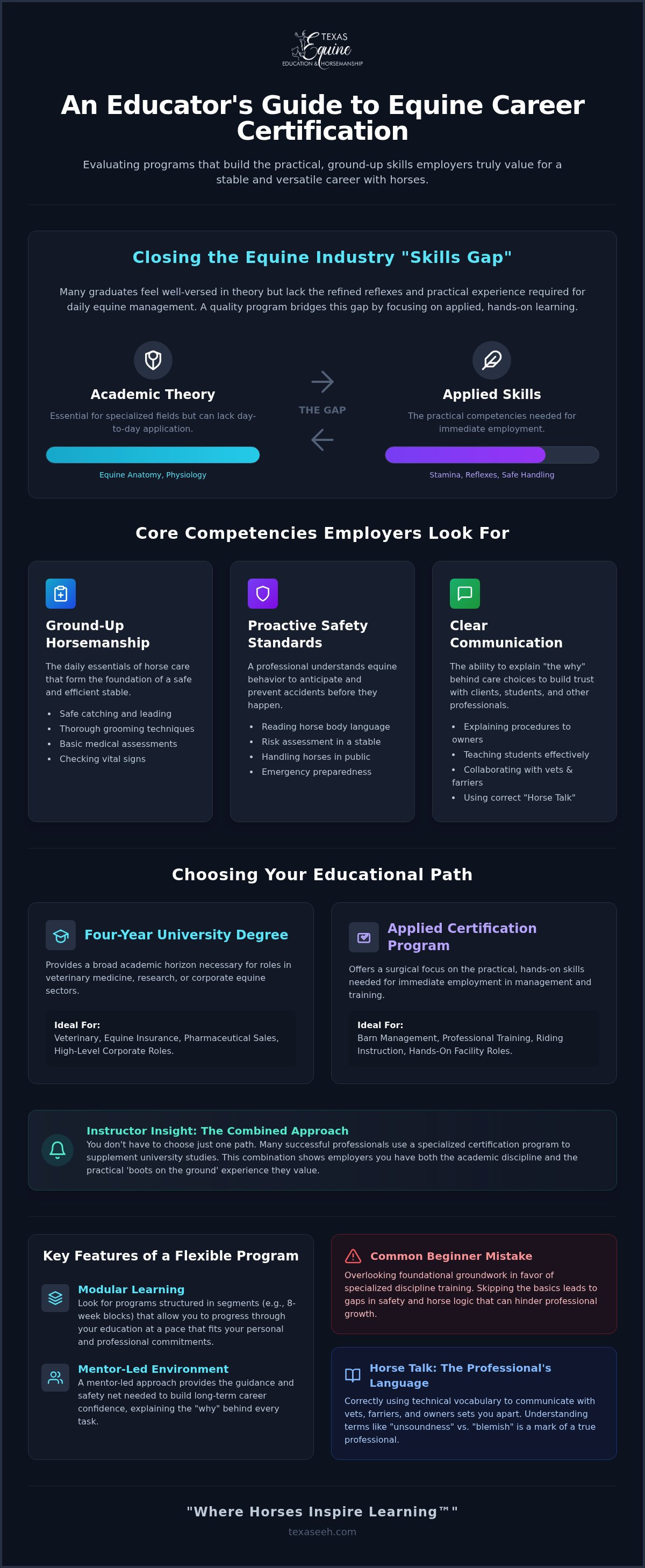
When you enter the professional workforce, employers look for specific "soft" and "hard" skills that keep a barn running smoothly. These include:
Ground-up horsemanship: This involves daily essentials like safe catching and leading, thorough grooming, and basic medical assessments like checking vital signs or identifying heat in a limb.
Safety standards: A professional must understand equine behavior to anticipate and prevent accidents before they happen. This proactive mindset is vital in a busy public or private stable.
Communication: You must be able to explain "the why" behind a specific care choice to a client or a student. Clear communication builds trust and establishes your authority as a knowledgeable professional.
The Importance of an Education-First Approach
Learning ground-up handling is often more critical than advanced riding skills for entry-level professionals. If you can't safely wrap a leg or manage a horse's diet, your ability to execute a perfect lead change becomes secondary in a management context. A mentor-led environment is essential here, as it provides the safety net needed to build long-term career confidence.
Common Beginner Mistake: Many students overlook foundational groundwork in favor of specialized discipline training like jumping or reining. While these skills are exciting, skipping the basics leads to gaps in safety and horse logic that can hinder your professional growth later on.
By focusing on the "why" behind every interaction, you develop a versatile skill set that applies to any breed or discipline. This foundational stability is what makes a graduate stand out during a hiring process.
Academic vs. Applied Learning: Finding Your Career Path
Choosing between a four-year university degree and a specialized equine industry certification program depends largely on your specific career goals. While a university degree is often necessary for those pursuing veterinary medicine or high-level corporate roles in equine insurance or pharmaceutical sales, many management and training positions prioritize applied skills. There is a noticeable "Skills Gap" where graduates feel well-versed in equine anatomy or exercise physiology but lack the physical stamina and refined reflexes required for daily barn management.
Professional credibility often starts with your ability to use "Horse Talk" correctly. This isn't just about jargon; it's about using technical vocabulary to communicate clearly with farriers, vets, and owners. Understanding terms like "unsoundness" versus "blemish," or knowing how to describe a horse's "conformation" accurately, sets you apart. This technical knowledge, paired with foundational horsemanship, creates a stable base for any career path you choose.
University Credit vs. Professional Certifications
For many students, a degree provides a broad educational horizon, but a certification offers the surgical focus needed for immediate employment. Modular learning is particularly helpful if you're already working or enrolled in university, as it allows you to build your resume in stages rather than waiting four years to enter the field.
Instructor Insight: You don't have to choose just one path. Many successful professionals use a specialized equine industry certification program to supplement their university studies. This combination shows employers you have both the academic discipline and the practical "boots on the ground" experience they value.
The Role of Internships in Professional Development
Real-world experience is the gold standard for equine hiring managers. However, not all experiences are equal. A quality program should offer mentorship that explains the "why" behind every task, rather than just using you for "barn chores" like mucking stalls without any educational context.
This is where equine internships become invaluable, acting as a bridge between textbook theory and the unpredictable nature of working with live animals.
Mentorship: Look for programs where experienced educators walk beside you, correcting your technique in real-time.
Problem Solving: Internships should challenge you to handle common barn emergencies and management hurdles.
Networking: Working in a professional environment connects you with industry leaders and future employers.
If you're ready to see how these practical skills come together, you can explore our horsemanship lessons to see these educational principles in action.
Evaluating Program Flexibility and Career Readiness
Life moves fast. Balancing a full-time job or university studies with a passion for horses can feel like a constant tug-of-war. This is why flexibility has become the most requested feature for students looking into an equine industry certification program. You need a path that respects your existing commitments while providing the depth of knowledge required to work professionally. A quality program shouldn't force you to choose between your education and your career; it should act as a bridge between the two.
Assessing a program's value also means looking at the end goal. Does the curriculum prepare you for the professional presentation required at events like the Horse & Rider Showcase™? True readiness means you can step into a high-pressure environment with the poise and technical skill that only comes from intentional, repetitive practice. It is about more than just knowing the facts; it is about demonstrating them with confidence.
Safety Reminder: Before enrolling, always check if the program includes specific ground-handling safety protocols. Professional readiness begins with the ability to manage a horse's space safely before ever setting foot in the stirrup.
The Modular Advantage for Career Changers
Traditional semester-long courses can be daunting, especially if your schedule changes frequently. 8-week modular segments offer a significant advantage for skill mastery. Unlike a weekend workshop that tries to cram months of information into two days, these segments allow for better retention. You have the time to let the "why" behind each task sink in. You can complete these modules consecutively or spread them out over multiple terms to fit your university schedule or seasonal work demands.
Texas Equine Tip: Look for programs that allow you to pause and resume as your schedule allows. A supportive learning environment should offer the stability to step away and return without losing your progress or feeling overwhelmed.
Mentorship and Professional Networking
There is no substitute for an experienced instructor walking beside you in the barn. While pre-recorded lectures have their place, real-time feedback is how you refine your "feel" with a horse. To supplement this hands-on work, virtual education sessions held on Thursdays can provide a vital touchpoint for theory and discussion. These sessions ensure you stay connected to your mentors even when you aren't physically at the stable.
Building a professional portfolio is another key part of readiness. Look for opportunities to demonstrate a well-rounded understanding of the industry through showcases or heritage art shows. These experiences allow you to document your progress and show future employers that you understand the cultural and heritage aspects of the horse world alongside the technical ones. To see how these elements come together, you can explore our flexible internship segments and start building your professional foundation today.
The Equine Industry Readiness Program™: A Ground-Up Solution
Traditional academic paths often require a four-year commitment that doesn't always align with the immediate needs of a working professional or a busy university student. The Equine Industry Readiness Program™ was created as a flexible alternative, focusing on the practical skills that define true competency in the stable. By choosing this equine industry certification program, you are prioritizing a curriculum that moves at your pace while ensuring no foundational step is skipped. It is a journey designed to build your confidence through direct, meaningful experience with the horses themselves.
Instructor Insight: We often see students who have the passion but lack the specific "boots on the ground" habits that managers look for. This program acts as a bridge to employment by teaching you to anticipate the needs of the horse and the facility, making you an asset from your very first day on the job.
The curriculum follows a logical progression, starting with foundational care and moving toward advanced horsemanship. You will learn to observe the subtle shifts in a horse's body language, manage complex feeding schedules, and maintain the high safety standards required in a professional environment. This ground-up approach ensures that you understand the "why" behind every action, creating a sense of stability that carries over into every aspect of your career.
8-Week Internship Segments Explained
Structure and consistency are vital when learning to work with animals. Our 8-week professional development modules are designed to provide deep immersion without the pressure of a full-semester commitment.
During a typical segment, you can expect:
Focused Mastery: Each module targets specific competencies, such as ground-handling proficiency or advanced equine care, allowing you to master one area before moving to the next.
Accumulative Growth: These segments aren't isolated; they accumulate toward a full professional certification, allowing you to document your progress over time.
Adaptive Learning: Because the segments are modular, they accommodate different learning speeds and life schedules, giving you the space to truly absorb the material.
Preparing for the Professional Showcase
A key part of your development is learning how to present your skills to the wider world. The Horse & Rider Showcase™ serves as a professional platform where you can demonstrate your progress. This virtual horse show format allows for national reach, integrating online education with physical performance. It is a wonderful way to build your portfolio and connect with a community that values the same high standards of horsemanship that you do.
If you feel ready to take the next step in your professional journey, we invite you to continue your learning by exploring our upcoming internship modules. Whether you are looking to shift careers or supplement your current education, our doors are open to help you find your place in the equine industry.
Building Your Future in the Equine World
Selecting the right path for your professional development is a significant step toward a rewarding career. You've learned that a quality equine industry certification program should prioritize ground-up care and the "why" behind every interaction. By choosing modular learning, you gain the stability to grow at your own pace without sacrificing your current responsibilities. True readiness comes from a balance of hands-on skill and the professional poise demonstrated in national showcases.
Part of this professional poise includes your presentation; many professionals use custom-branded apparel from Embroidery By Shotzy to ensure their appearance matches their expertise during these important career milestones.
Our "Where Horses Inspire Learning™" philosophy ensures that every lesson serves your long-term success. Whether you're a university student or a professional looking for a new direction, these flexible 8-week segments provide a clear bridge to the industry. You don't have to navigate this journey alone; a supportive community of mentors is ready to walk beside you. This approach fosters the confidence needed to handle management tasks independently and safely.
Take the next step in your professional journey today. We invite you to explore our Equine Industry Readiness Program™ modules to see how our segments can fit your life. We look forward to helping you build the skills needed to thrive in the world of horses.
Frequently Asked Questions
What is the difference between an equine degree and an equine industry certification program?
A university degree is a broad, four-year academic commitment focused on science or business, while an equine industry certification program validates specific professional skills. Certification programs often prioritize hands-on readiness and ground-up care over long-term theory. This targeted approach allows you to demonstrate competency to employers more quickly than a traditional path, focusing on the practical application of horsemanship in a professional barn environment.
Can I complete an equine certification while attending university full-time?
Yes, many students choose a modular equine industry certification program specifically to fit around a busy university schedule. Because these programs often use 8-week segments, you can complete a module during a summer break or alongside your regular coursework. This flexibility allows you to build a professional resume while you finish your degree, giving you a head start in the workforce without overwhelming your schedule.
Do I need prior horse experience to enroll in an equine industry readiness program?
No, you don't need prior experience to begin your educational journey. A ground-up program is designed to teach you the right habits from day one, ensuring you learn safe handling and care without carrying over common beginner mistakes. Starting with a solid educational foundation helps you build confidence and stability as you progress through more advanced horsemanship levels under the guidance of a mentor.
How long does it typically take to become certified in the equine industry?
The timeline depends on the program's structure and your personal schedule. In a modular system, you might complete an initial professional development segment in just 8 weeks. To reach full certification, many students spend several months to a year moving through consecutive modules. This step-by-step process ensures you truly master each skill, from foundational care to advanced handling, before advancing to the next professional stage.
Are online equine certifications respected by professional barn managers?
Professional barn managers respect certifications that combine virtual education with verifiable hands-on experience. While online theory provides the "why" behind equine care, managers look for proof of practical skill, such as participation in a showcase or an internship. A program that uses virtual sessions to supplement physical training offers a well-rounded education that meets modern industry standards for safety and management proficiency.
What kind of jobs can I get with an equine industry readiness certification?
Graduates often pursue roles in barn management, equine care, training assistance, or educational coaching. This certification prepares you for the daily physical and administrative demands of a professional stable. Whether you want to work in a therapeutic center, a private breeding farm, or a public riding school, the foundational skills you gain provide a versatile base for many different career paths in the horse world.


Comments