


Adaptive Riding: A Professional Guide to Benefits & Access

When considering adaptive riding, start with what the rider hopes to learn and what support could make participation accessible. Terms such as adaptive riding, therapeutic riding, and hippotherapy can sound interchangeable, but they may describe different services with different purposes and providers.
This guide explains how adaptive riding may involve horsemanship instruction adjusted through equipment, assistance, lesson pace, or teaching approach. It also distinguishes riding instruction from clinical hippotherapy and offers practical questions to ask about instructor experience, accessibility, safety, and program fit. The goal is to help you make an informed decision, not to promise results or recommend a particular program.
Table of Contents
What Is Adaptive Riding? Understand the Approach and Its Limits
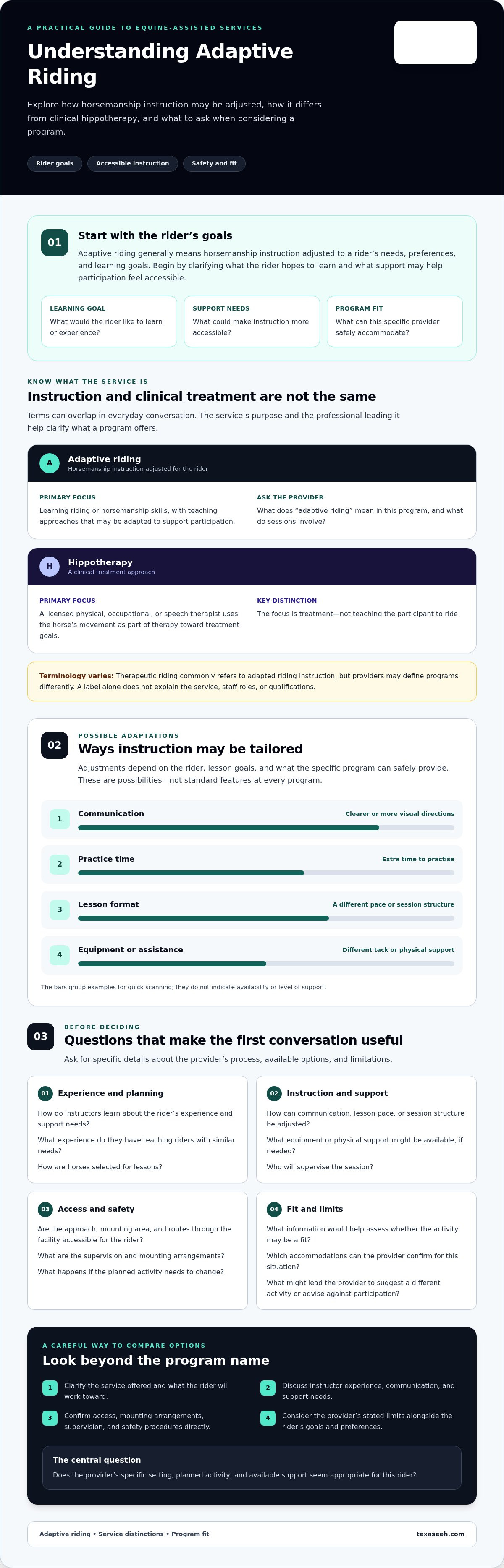
Adaptive riding is horsemanship instruction adjusted to a rider’s needs, preferences, and learning goals. The focus is on learning riding or horsemanship skills. The instructor may adapt the teaching approach to support the rider’s participation. Since providers don’t always use the term in the same way, ask what a program means by adaptive riding and what its sessions involve.
Terms for equine-assisted services can overlap in everyday conversation, but the service’s purpose and the professional leading it matter. Therapeutic riding commonly refers to adapted riding instruction, although providers may define their programs differently. Ask who plans and leads sessions, what the rider will work toward, and whether the service is instruction or clinical care.
How Is Adaptive Riding Different from Therapeutic Riding or Hippotherapy?
Hippotherapy is a clinical treatment approach in which a licensed physical, occupational, or speech therapist uses the horse’s movement as part of therapy. Its focus is treatment goals, not teaching the participant to ride. The American Hippotherapy Association describes hippotherapy as a treatment strategy used by therapists, which helps distinguish it from riding instruction.
Adaptive riding and therapeutic riding are often used to describe adapted horsemanship instruction, but a label alone does not tell you how a program works or what qualifications its staff have. Ask the provider to explain its service, staff roles, and goals. A therapeutic riding explainer or equine-assisted services guide may provide background, but direct questions are essential to understand what a specific program offers.
How Adaptive Riding May Be Tailored to a Rider
A provider may ask about the rider’s goals, experience, preferences, and support needs before participation. This discussion can clarify what the rider wants to learn and what might make instruction more accessible. Sharing relevant information helps the provider explain what it can accommodate and where its limits are.
Possible adjustments include giving clearer or more visual directions, allowing extra time to practise, changing a session’s pace or structure, or considering different tack. Some programs may also provide physical assistance, such as support from a side walker. These are examples, not standard features available at every program.
Accommodations depend on the rider, the lesson goals, and what the specific program can safely provide. Discussing needs in advance helps both sides consider whether the proposed setup may be a reasonable fit. It does not mean every requested adjustment will be possible.
What Can a Rider or Support Person Ask Before a First Session?
Make the initial conversation specific. Ask how instructors learn about a rider’s experience and support needs, what experience they have teaching riders with similar needs, and how they select horses for lessons. Confirm who will supervise and which accessibility features or adaptations may be available.
How can the instructor adjust communication, lesson pace, or session structure?
What equipment or physical support might be available, if needed?
Are the approach, mounting area, and routes through the facility accessible for the rider?
What information would help the provider assess whether the activity may be a fit?
Describe the rider’s needs and preferences in their own terms, then confirm practical arrangements directly with the provider. Ask for details rather than relying on a general description such as “accessible.” The provider can explain its process, available options, and limits, giving the rider and support person a clearer basis for deciding whether to take the next step.
How to Explore Adaptive Riding Options with Care
Start by identifying what the rider wants from the experience. That might mean learning riding skills, becoming more familiar with horses, or participating with specific kinds of support. Then contact programs, describe the rider’s goals and preferences, and ask how they assess fit, what activities they offer, and what they can or cannot accommodate.
Discuss access and safety before making a decision. Ask about the route from arrival to the lesson area, mounting arrangements, supervision, and what happens if the planned activity needs to change. A program description cannot establish whether a particular setting is suitable. That depends on the rider, the environment, and the provider’s practices, so confirm arrangements directly.
What Information Helps You Compare Programs Responsibly?
Look beyond the program name. Compare the service being offered, instructors’ relevant experience, communication practices, accessibility, and safety procedures. Ask how the provider decides whether its setting, horse, and planned activities suit the rider’s needs. A clear explanation of limitations is useful information and can help you decide whether to continue the conversation.
What goals and support needs does the provider consider when discussing fit?
How are instruction and safety plans explained to the rider and support person?
Which access features and accommodations can the provider confirm for this situation?
What might lead the provider to suggest a different activity or advise against participation?
Compare the answers and consider whether the proposed setting feels appropriate. If details about access, safety, or support remain unclear, ask follow-up questions before deciding. A careful conversation gives the rider and support person a clearer basis for choosing whether to proceed.
Take the Next Step with Clear Questions
Explore adaptive riding by starting with the rider’s goals and speaking directly with each provider. Because lesson approaches and accommodations vary, ask how the program assesses fit, what support it may offer, and how it handles access and safety. Compare the answers before deciding whether to proceed.
For background on equine-assisted services, read Texas Equine Education & Horsemanship™’s equine-assisted services guide. Texas Equine Education & Horsemanship™ offers foundational horsemanship and equine care education. Use the guide to learn more about those educational offerings, then ask any provider directly about adaptive riding options and accommodations.
Frequently Asked Questions
Is adaptive riding the same as therapeutic riding?
Not always. “Adaptive riding” often describes horsemanship instruction adjusted for a rider, while some providers use “therapeutic riding” in a similar way. Terminology varies. Clinical services have a different purpose and may be delivered by licensed clinicians. Ask each program how it defines its service, who leads sessions, and whether the focus is riding instruction or clinical treatment.
Who can participate in adaptive riding?
Participation depends on the individual and a provider’s services, setting, and assessment process. A diagnosis alone does not determine whether a program is suitable, and there is no single eligibility description that applies everywhere. Contact the program to discuss the rider’s goals, experience, preferences, and support needs. The provider can explain what it considers and whether its activities may be a fit.
What happens during an adaptive riding session?
A session may begin with a conversation about the rider’s goals and needs, followed by horsemanship instruction shaped by the provider’s approach. Possible adjustments may involve communication, lesson pace, equipment, or session structure, but these are not available at every program. Ask what a specific provider includes, how it plans instruction, and what support or accommodations it can offer.
How do I choose an adaptive riding program?
Compare programs by asking about instructors’ relevant experience, facility accessibility, safety procedures, and available adaptations. Find out how the provider learns about the rider’s needs and decides whether its setting and activities are suitable. Share relevant information before participation and ask for clear details about arrangements and limitations. A direct conversation can help you assess fit without assuming every program works the same way.


Comments