


Understanding Horse Tack: Essential Parts of a Bridle

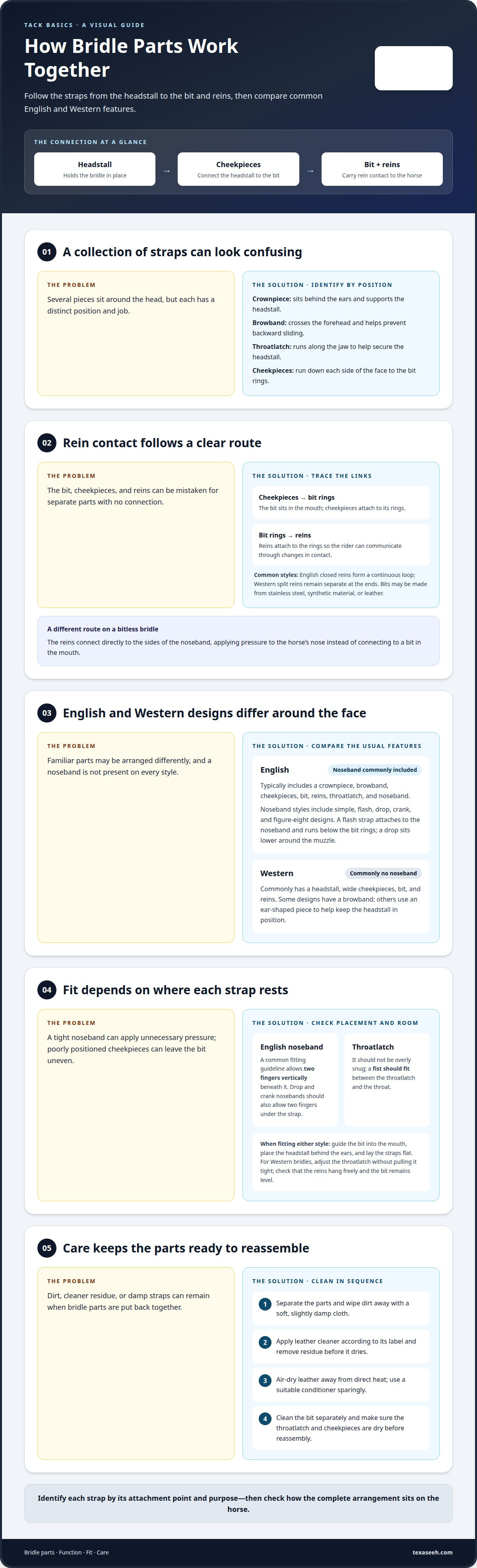
What makes a bridle work as one piece of equipment rather than a collection of straps? The parts of a bridle fit together around the horse’s head: the headstall holds it in place, cheekpieces connect to the bit, and reins attach to the bit so the rider can communicate through them. Other parts, such as the browband, throatlatch, and noseband, help position or support the bridle.
The straps can look confusing at first, and their arrangement differs between English and Western bridles. This guide explains what each basic part does, how the pieces connect, and which features commonly vary between the two styles. Understanding how the bridle fits together makes it easier to identify each part and its role.
Table of Contents
Bridle headstall, bit, and reins
The headstall is the framework that holds a bridle on a horse’s head. Its crownpiece sits behind the ears, while cheekpieces connect the crownpiece to the bit. The throatlatch runs along the jaw and helps secure the headstall. A browband crosses the forehead and helps prevent the bridle from sliding backward. Depending on its design, the noseband rests around the nose.
The bit sits in the horse’s mouth, with cheekpieces attached to its rings. Bits may be made from stainless steel, synthetic material, or leather. Reins connect to the bit rings, giving the rider a way to communicate through rein pressure. Common rein styles include English closed reins, which form a continuous loop, and Western split reins, which remain separate at the ends.
A conventional bridle has reins connected to a bit in the horse’s mouth. On a bitless bridle, the reins connect directly to the sides of the noseband, applying pressure to the horse’s nose instead.
Reins communicate directional and stopping cues through changes in contact. For example, a rider may take up one rein to signal a turn, while balanced contact on both reins can support a halt. Clear signals depend on how the rider uses the reins, not simply on the bridle’s parts.
To care for a leather bridle, first separate its parts and wipe away dirt with a soft, slightly damp cloth. Apply leather cleaner according to its label, then remove any residue before it dries. Let the leather air-dry away from direct heat, and use a suitable conditioner sparingly. Clean the bit separately, and make sure the throatlatch and cheekpieces are dry before reassembly.
English and Western bridles
English and Western bridles arrange familiar pieces differently, especially around the nose and cheekpieces. Their designs affect which straps are present and where each one sits.
English Bridle Parts and Fitting
An English bridle typically has a crownpiece, browband, cheekpieces, bit, reins, throatlatch, and noseband. To put it on, hold the headstall, gently guide the bit into the horse’s mouth, then bring the crownpiece behind the ears. Adjust the straps so they lie flat and the bit sits correctly.
Position the noseband according to its style, leaving room between the leather and the horse’s head. A common fitting guideline allows two fingers vertically beneath the noseband. The throatlatch should not be overly snug; a fist should fit between it and the throat.
English Bridle Styles and Nosebands
English styles include a simple noseband, a flash, a drop, a crank, and a figure-eight design. A flash strap attaches to the noseband and runs below the bit rings. A figure-eight noseband crosses the face in an eight-shaped pattern, while a drop noseband sits lower around the muzzle.
These noseband types change how straps sit around the horse’s face, so positioning matters. A drop noseband should allow two fingers vertically beneath it, and a crank noseband should also allow two fingers under its strap. Choose a configuration suited to its intended use, and ensure each strap sits without excessive tightness.
Western Bridle Components
A Western bridle commonly has a headstall, cheekpieces, bit, and reins, with wide cheekpieces and no noseband. The exact straps vary by design. Some Western bridles also have a browband, while others use an ear-shaped piece to help keep the headstall in position.
When fitting a Western bridle, guide the bit into the horse’s mouth, place the headstall behind the ears, and lay each cheekpiece flat. Adjust the throatlatch without pulling it tight, then check that the reins hang freely and the bit remains level.
Basic parts of a bridle
Each bridle part has a specific place and function, from holding the headstall in position to connecting the rider’s hands with the horse. Knowing how the browband, crownpiece, cheekpieces, throatlatch, noseband, bit, and reins fit together makes the equipment easier to identify.
Crownpiece: Sits behind the ears and supports the headstall; the cheekpieces and noseband attach to it.
Browband: Crosses the forehead and connects to the crownpiece below the ears. It helps prevent the bridle from sliding backward.
Cheekpieces: Run down each side of the face, connecting the crownpiece to the bit rings.
Throatlatch: Attaches to both sides of the crownpiece and runs along the jaw to help keep the bridle in place.
Noseband: Attaches to the crownpiece and wraps around the nose or jaw, depending on its style. It helps keep the jaw aligned and the horse from dislodging the bit.
Bit and reins: The bit sits in the mouth, and the reins connect to its rings so the rider can communicate through rein contact.
During riding, each piece works in relation to the others. For example, a browband that shifts backward may affect the headstall’s position, while cheekpieces hold the bit at the intended height. A flash strap is an additional piece attached to some nosebands, running below the bit rings.
Fit matters because straps rest against sensitive areas of a horse’s head. A noseband that is too tight can apply unnecessary pressure, while poorly positioned cheekpieces can leave the bit uneven. Identify each strap by its attachment point and purpose, then assess how the complete arrangement sits on the horse.
Texas Equine Education & Horsemanship™
Texas Equine Education & Horsemanship™ helps riders build practical understanding of horses, tack, and foundational horsemanship. Knowing a bridle’s components is a useful starting point; learning how tack fits into broader horse care and riding skills can deepen that understanding.
Horsemanship Lessons help students develop foundational riding knowledge, while Equine Care Classes build a broader understanding of horse care. These educational options can connect equipment terms with hands-on learning and responsible horse handling.
Take a welcoming next step in your horsemanship learning with Texas Equine Education & Horsemanship™.
Understand the Bridle’s Role
Understanding the bridle can help you observe how it supports communication between horse and rider. Notice how the bridle relates to the horse, the activity, and the rider’s experience.
Build your understanding by observing the bridle in use and considering how it fits into handling and riding. Each experience can help you connect what you learn about the bridle with how you use it.
Keep asking questions and let your understanding of the bridle grow at a pace that feels right for you.
Frequently Asked Questions
What Are the Parts of the Bridle?
The parts of a bridle form a connected arrangement that keeps the equipment positioned and gives the rider a way to communicate. A standard setup includes a headstall, cheekpieces, browband, throatlatch, noseband, bit, and reins. Arrangements vary: a bitless design has no mouthpiece, while a double bridle uses two bits.
What are Horse Bridles?
Horse bridles are headgear used while riding to help a rider communicate with a horse through the reins. In a conventional bridle, rein pressure acts through a bit; in a bitless bridle, reins connect to the noseband and apply pressure to the horse’s nose. A bridle differs from a halter, which is primarily used for leading and tying.
What are the main parts of a horse bridle?
The main parts are the headstall, browband, cheekpieces, throatlatch, noseband, bit, and reins. Their roles differ: the headstall supports the assembly, cheekpieces position the bit, and reins carry the rider’s signals. Some designs include a flash strap or another noseband feature, but these are not part of every bridle.
What are the parts of an English bridle?
An English bridle commonly has a crownpiece, browband, cheekpieces, throatlatch, noseband, bit, and reins. Noseband styles vary, so an English bridle may also include an attached flash strap. A double bridle is a distinct arrangement that uses two bits. Recognizing optional pieces helps distinguish a particular setup from the basic bridle structure.
How should a bridle fit a horse?
A bridle should sit evenly, with straps lying flat and without excessive tightness. Check that the bit is level and the cheekpieces hold it in position; the noseband and throatlatch should not restrict the horse. Never use the bit to tie a horse or attach cross ties. These checks help identify a poor fit before riding.



Comments