


Exquisite Horse Paintings: A Guide to Equine Artistry

A horse portrait is about more than the animal. Horse paintings may bring together a herd, place riders in American West scenes, highlight the distinct character of breeds, or capture the focus and movement of an equestrian discipline. Subject, setting, and composition all shape what a work conveys.
A horse’s beauty may catch your eye first, but the details around it can be just as revealing. This guide explores how artists portray groups of horses, evoke the American West, distinguish breeds, and depict disciplines such as dressage and racing. Learn what to notice in each kind of equine artwork and how those choices shape its mood, story, and sense of movement.
Table of Contents
Group portraits featuring multiple horses
Popular styles include realistic herd scenes, formal stable portraits, and expressive modern compositions. Among horse paintings, Rosa Bonheur’s The Horse Fair combines detailed horses with human activity, while contemporary artists may simplify forms, exaggerate color, or focus on movement.
Bonheur’s painting offers a clear example of how a group portrait can tell a larger story. It was exhibited at the Salon of 1853, completed in 1855, and is now at the Metropolitan Museum of Art in New York City. Its horses move through a busy scene rather than standing as isolated subjects. Their varied positions create rhythm, while the surrounding people establish scale and context.
Group compositions depend on more than how many horses appear. Artists use spacing, overlapping bodies, and changes in direction to guide your eye. A horse in the foreground can anchor the scene, while smaller figures behind it suggest distance. Notice head positions and body language, too: a closely gathered herd may feel settled, while horses moving in different directions add energy or tension.
Alfred Munnings brought another kind of group portrait to equine art. During World War I, he served as a war artist and painted the Canadian Cavalry Brigade and Canadian Forestry Corps in France. These works connect horses to people, work, and place, showing how a group portrait can record a shared experience as well as individual animals.
Modern horse paintings also expand how artists represent horses together. Pablo Picasso introduced horses into his work in 1905-06, including Boy Leading a Horse. Eadweard Muybridge’s photographic studies, published in 1887, helped artists examine movement and gait. Together, these examples show how artists can balance recognizable anatomy with abstraction, sequence, or bold design.
A commissioned portrait of Briony's horse and foal measured 30 x 20 inches. The artist prepares a portrait mockup before beginning to paint, and horse portraits are shipped worldwide.
American West horse art
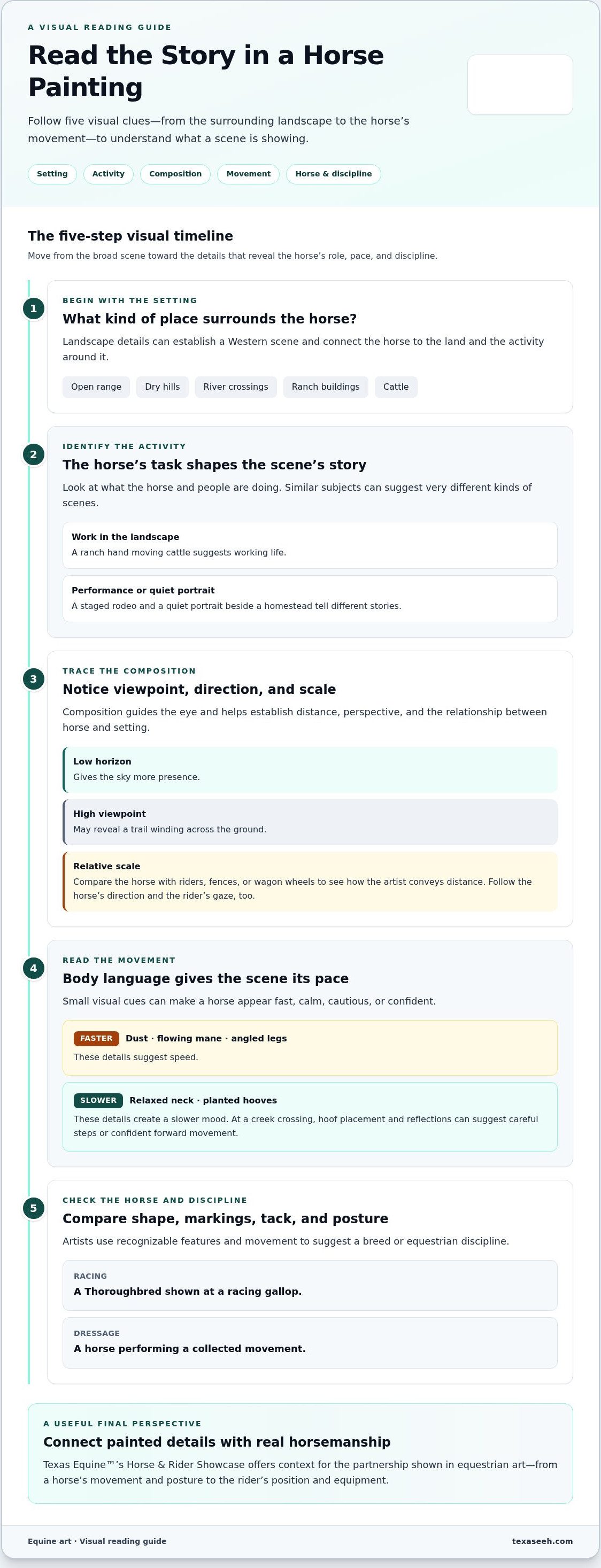
American West horse paintings often set horses within a broader landscape. Open range, dry hills, river crossings, ranch buildings, and cattle can establish the setting. A rider’s position also shapes the story: a mounted figure watching a herd suggests work, while a lone horse near a distant ridge creates a quieter scene. Such details connect the horse to the land and the activity around it.
Composition helps you read the scene. A low horizon gives the sky more presence, while a high viewpoint may reveal a trail winding across the ground. Dust, a flowing mane, and angled legs suggest speed; a relaxed neck and planted hooves create a slower mood. Compare the horse’s scale with nearby riders, fences, or wagon wheels to see how the artist conveys distance.
Famous artists known for equine subjects include George Stubbs and Eugène Delacroix. Stubbs’s Whistlejacket, dated about 1762, is held by the National Gallery in London. Delacroix painted Horse Frightened by Lightning between 1825 and 1829. Their works offer useful comparisons for studying anatomy, gesture, and dramatic movement, even when a viewer is looking at a distinctly American Western scene.
Western imagery may seem familiar, but its details matter more than a cowboy stereotype. A ranch hand moving cattle, a staged rodeo, and a quiet portrait beside a homestead tell different stories. Look at the tack, clothing, terrain, and the horse’s task. These clues help distinguish working life from theatrical storytelling and show which elements the artist emphasizes.
To read a scene more closely, start with the setting, then follow the horse’s direction and the rider’s gaze. In a creek crossing, for example, hoof placement and reflections in the water can suggest whether the horse is stepping carefully or moving forward with confidence.
Painting different horse breeds and disciplines
For a room, choose a painting’s size and style by considering wall space, viewing distance, and the room’s colors. A 16-by-12-inch canvas suits an intimate head study; 18-by-14-inch to 20-by-16-inch canvases offer a medium portrait, while 24-by-18-inch and larger works make a stronger focal point.
Materials shape the artwork’s surface and appearance. Artists may use oil, watercolor, or acrylic on canvas or paper, applying layered color, loose brushwork, or detailed glazing. George Stubbs’s Whistlejacket, dated about 1762, is a useful example of a horse portrait focused on anatomy.
An original is a one-of-a-kind work created by the artist. A print reproduces an image, while a reproduction may copy an existing artwork. Labels, signatures, edition details, and documentation can help distinguish them. Value depends on factors such as the artist, condition, provenance, and medium, so there is no useful typical price without assessing a specific work.
No single painting can be identified here as the most valuable ever sold. George Stubbs’s Whistlejacket is a celebrated equine painting, but its importance alone does not establish a sale record.
To preserve a painting, keep it away from direct sunlight, damp areas, and heat sources. Hold framed works by their sides, and leave cleaning or damage to a qualified conservator rather than using household products.
Texas Equine Education & Horsemanship™: Horse & Rider Showcase
Texas Equine Education & Horsemanship™ offers the Horse & Rider Showcase for readers interested in how horses and riders work together. Observing their partnership can add context to equestrian artwork, from a horse’s movement and posture to the rider’s position and equipment.
The Showcase is a useful way to connect the disciplines depicted in paintings with real horsemanship. For a hands-on introduction, an Introductory Lesson offers a starting point for learning about riding, while Equine Care Classes focus on understanding horses beyond their appearance in art.
Explore the Horse & Rider Showcase or contact Texas Equine Education & Horsemanship™ to learn more.
Let Your Interest in Equine Art Grow
Horse paintings invite us to consider the many ways people interpret horses through art. To explore equine creativity further, Texas Equine Education & Horsemanship™ offers the Equine Expression & Heritage Art Show, which celebrates this connection.
Art can help you notice a horse’s character and the stories people build around it. The show offers a place to engage with that creative connection.
Explore the Equine Expression & Heritage Art Show and continue your interest in equine art.


Comments